Clasificación / Nombres
Nombres comunes | Sinónimos | Catalog of Fishes(Género, Especie) | ITIS | CoL | WoRMS | Cloffa
>
Cypriniformes (Carps) >
Cyprinidae (Minnows or carps) > Torinae
Etymology: Carasobarbus: Latinization of , karass, karausche, European crucian carp + Latin, barbus = barbel (Ref. 45335).
Entorno: milieu / zona climática / rango de profundidad / gama de distribución
Ecología
; agua dulce bentopelágico. Tropical
Distribución
Territorios | Áreas FAO | Ecosistemas | Ocurrencias, apariciones | Mapa de puntos | Introducciones | Faunafri
Asia: Iran.
Tamaño / Peso / Edad
Madurez: Lm ? range ? - ? cm
Max length : 19.1 cm SL macho / no sexado; (Ref. 132288)
Descripción breve
Claves de identificación | Morfología | Morfometría
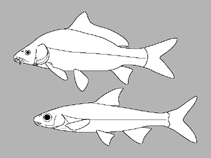
This species is distinguished by the following characters: scales on lateral line 32-34; with slightly developed lower lip lobe; head short 20-24% SL; posterior barbel short 13-20% HL; snout short 25-31% HL; with two pairs of barbels; well-developed median lobe on the lower lip (Ref. 132288).
Cross section: oval.
Usually in deep, swiftly flowing sections of rivers and dam reservoirs, prefers areas with abundant vegetation, and during the summer, it can also be observed in shallower waters. It is generally most abundant in the middle and lower Karkheh drainage. Associated species includes: Luciobarbus esocinus, Capoeta shajariani, Garra gymnothorax, Chondrostoma regium, Alburnus sellal, Squalius lepidus, Squalius berak, Turcinoemacheilus saadii, Glyptothorax cous and G. alidaei (Ref. 132288).
Ciclo vital y comportamiento de apareamiento
Madurez | Reproducción | Puesta | Huevos | Fecundidad | Larva
Jouladeh-Roudbar, A., C. Kaya, S. Vatandoust and H.R. Ghanavi, 2024. New insights into the phylogeny of Carasobarbus Karaman, 1971 (Actinopterygii, Cyprinidae) with the description of three new species. Scientific Reports 14(21801):1-22. (Ref. 132288)
Situación en la Lista Roja de la UICN (Ref. 130435: Version 2025-2 (Global))
Amenaza para el ser humano
Harmless
Usos humanos
Pesquerías: sin interés
Herramientas
Informes especiales
Descargar XML
Fuentes de Internet
Estimaciones basadas en modelos
Índice de diversidad filogenética (Referencia
82804): PD
50 = 0.5001 [Uniqueness, from 0.5 = low to 2.0 = high].
Bayesian length-weight: a=0.00955 (0.00430 - 0.02123), b=3.02 (2.83 - 3.21), in cm total length, based on LWR estimates for this (Sub)family-body shape (Ref.
93245).
Nivel trófico (Referencia
69278): 3.0 ±0.4 se; based on size and trophs of closest relatives
Resiliencia (Referencia
120179): Medio, población duplicada en un tiempo mínimo de 1.4-4.4 años (Preliminary K or Fecundity.).
Vulnerabilidad pesquera (Ref.
59153): Low vulnerability (13 of 100).
🛈