Classification / Noms
Noms communs | Synonymes | Catalog of Fishes(Genre, Espèce) | ITIS | CoL | WoRMS | Cloffa
>
Cypriniformes (Carps) >
Nemacheilidae (Brook loaches)
Etymology: taretensis: Named after the Taret River, its type locality; an adjective.
Environnement : milieu / zone climatique / profondeur / gamme de distribution
Écologie
; eau douce démersal; profondeur 0 - 1 m (Ref. 132199). Tropical
Asia: India.
Taille / Poids / Âge
Maturité: Lm ? range ? - ? cm
Max length : 6.4 cm TL mâle / non sexé; (Ref. 132199)
Description synthétique
Clés d'identification | Morphologie | Morphométrie
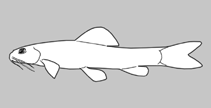
This species is distinguished from all its congeners by the following set characters: dorsal fin with 9½ or 10½ branched rays; caudal fin with 9+8 or 8+8 or 8+7 branched rays; lateral line is complete; with axillary pelvic lobe; processus dentiformis is poorly developed; male with suborbital flap; body depth 12.8-16.0 % SL. Colouration: body with 12-13 irregular dark-brown blotches or bars on flank, alternately arranged with 11-16 dark brown saddles of varying shape and size on the back; dorsum of head with a distinct rhomboid dark brown mark encircling a pale oval area on the nape; basicaudal bar black, with its dorsal extremity presenting as a small, slightly oblique blotch, its ventral extremity presenting as a vertically elongated blotch, more or less connected by an indistinct black region between the two (Ref. 132199).
Cross section: oval.
This species occurs in cool, clear, swift-flowing freshwater streams over a substrate of gravel, cobble and boulders covered in lush green algal growth. It was collected from shallow clearwater regions of depth ~0.5-0.8 m. Associated species were Neolissochilus paucisqamatus,
Opsarius dogarsinghi, O. ngawa, Botia histrionica, Schistura rubrimaculata, Glyptothorax trilineatus, and Batasio affinis. The two dissected females (3.88-4.18 cm SL) have unripe ovaries and the stomachs in both contain unidentifiable vegetable matter (Ref. 132199).
Cycle de vie et comportement reproducteur
Maturité | Reproduction | Frai | Œufs | Fécondité | Larves
Chinglemba, Y., Y. Rameshori and W. Vishwanath, 2021. A new species of stone loach of the genus Mustura (Teleostei: Nemacheilidae) from Chindwin River drainage, Manipur, north-eastern India. Zootaxa 5081(4):551-565. (Ref. 132199)
Statut dans la liste rouge de l'IUCN (Ref. 130435: Version 2025-2 (Global))
Menace pour l'homme
Harmless
Utilisations par l'homme
Pêcheries: sans intérêt
Outils
Articles particuliers
Télécharger en XML
Sources Internet
Estimations basées sur des modèles
Indice de diversité phylogénétique (Réf.
82804): PD
50 = 0.5000 [Uniqueness, from 0.5 = low to 2.0 = high].
Bayesian length-weight: a=0.00724 (0.00352 - 0.01491), b=3.01 (2.84 - 3.18), in cm total length, based on LWR estimates for this (Sub)family-body shape (Ref.
93245).
Niveau trophique (Réf.
69278): 2.8 ±0.3 se; based on size and trophs of closest relatives
Résilience (Réf.
120179): Haut, temps minimum de doublement de population inférieur à 15 mois (Preliminary K or Fecundity.).
Vulnérabilité de la pêche (Ref.
59153): Low vulnerability (10 of 100).
🛈