Klassifizierung / Names
Namen | Synonyme | Catalog of Fishes(Gattung, Arten) | ITIS | CoL | WoRMS | Cloffa
>
Cyprinodontiformes (Rivulines, killifishes and live bearers) >
Rivulidae (Rivulines) > Cynolebiinae
Etymology: adrianae: Named for Adriana Almirón, for her valuable contributions to Neotropical Ichthyology; matronymic in the genitive case.
Umwelt: Milieu / Klimazone / Tiefenbereich / Verbreitungsgebiet
Ökologie
; süßwasser pelagisch; tiefenbereich 0 - 1 m (Ref. 132069). Tropical
South America: Argentina.
Größe / Gewicht / Alter
Geschlechtsreife: Lm ? range ? - ? cm
Max length : 5.1 cm SL Männchen/unbestimmt; (Ref. 132069); 3.4 cm SL (female)
Kurzbeschreibung
Bestimmungsschlüssel | Morphologie | Morphometrie
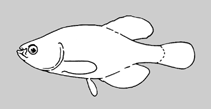
Rückenflossenweichstrahlen (insgesamt) : 17 - 24; Afterflossenweichstrahlen: 18 - 22; Wirbelzahl: 28. This species is distinguished from other congeners by its unique coloration: distinct dark grey to black anterior third portion (about to the 7th or 8th rays) of the dorsal fin in adult males (vs. black portion reduced to first to third anterior dorsal fin rays); absence of iridescent spots on basal half of pectoral fin in adult males (vs. present in Argolebias nigripinnis and Argolebias guarani); anterocentral portion of flanks in females have dark grey spots (vs.none in Argolebias nigripinnis and Argolebias paranaensis) (Ref.132069).
Cross section: compressed.
The pond where sample species were collected has a surface area of approximately 4 × 6 m and a maximum depth of 45 cm and this is surrounded by emerging basalt stones and completely covered by aerial vegetation from the surrounding jungle. In six different occasions, when the pond was dry, the soil was covered by a layer of leaf litter, trunks, branches, and some terrestrial vascular plants. Beneath this layer, the soil appeared to be composed of clay mixed with decomposing plant debris, with the soil consistently moist, and no dry portions. In seven different occasions, when the pond contained water, it was generally clear to tea-colored, sometimes slightly muddy in the deeper portions. there were no aquatic plants present in the pond, but surrounding vegetation was partially submerged during periods of maximum water level. The pond apparently overflows to surrounding areas when precipitation fills it and although the temporary wetland can intermittently extend to nearby areas of the jungle during these times, these areas are not very deep and appear to be more ephemeral. Collection was done in the deepest part of this environment (Ref. 132069).
Lebenszyklus und Paarungsverhalten
Geschlechtsreife | Fortpflanzung | Ablaichen | Eier | Fruchtbarkeit | Larven
Alonso, F., G.E. Terán, P. Calviño, W.S. Serra, M.M. Montes, I.D. García, J.A. Barneche, L. Ciotek, P. Giorgis and J. Casciotta, 2024. Expect the unexpected: a new species of killifish from a highly stochastic temporary wetland near Iguazú Falls (Cyprinodontiformes: Rivulidae). Can. J. Zool. 102(3):298-314. (Ref. 132069)
IUCN Rote Liste Status (Ref. 130435: Version 2025-2 (Global))
Bedrohung für Menschen
Harmless
Nutzung durch Menschen
Tools
Zusatzinformationen
Download XML
Internet Quellen
Schätzungen auf der Grundlage von Modellen
Phylogenetischer Diversitätsindex (Ref.
82804): PD
50 = 0.5625 [Uniqueness, from 0.5 = low to 2.0 = high].
Bayesian length-weight: a=0.00741 (0.00370 - 0.01485), b=3.06 (2.88 - 3.24), in cm total length, based on LWR estimates for this species & (Sub)family-body (Ref.
93245).
Trophische Ebene (Ref.
69278): 3.2 ±0.4 se; based on size and trophs of closest relatives
Widerstandsfähigkeit (Ref.
120179): hoch, Verdopplung der Population dauert weniger als 15 Monate. (Preliminary K or Fecundity.).
Anfälligkeit der Fischerei (Ref.
59153): Low vulnerability (10 of 100).
🛈