Classification / Noms
Noms communs | Synonymes | Catalog of Fishes(Genre, Espèce) | ITIS | CoL | WoRMS | Cloffa
>
Anguilliformes (Eels and morays) >
Congridae (Conger and garden eels) > Bathymyrinae
Etymology: Rostroconger: Name from the Latin 'rostrum' referring to the bony projection from the snout, and Conger, a genus of congrid eel; macrouriceps: Name from family Macrouridae (gadiform fishes) and Latin 'ceps' for head, referring to the macrourid-like appearance of the bony rostrum at the tip of the snout.
Environnement : milieu / zone climatique / profondeur / gamme de distribution
Écologie
marin benthopélagique; profondeur 244 - 296 m (Ref. 129618). Tropical
Distribution
Territoires | Zones FAO | Écosystèmes | Occurrences | Carte par point | Introductions | Faunafri
Western Pacific: Philippines.
Taille / Poids / Âge
Maturité: Lm ? range ? - ? cm
Max length : 24.1 cm TL mâle / non sexé; (Ref. 129618)
Description synthétique
Clés d'identification | Morphologie | Morphométrie
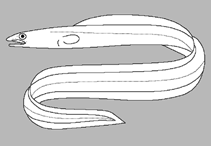
This species is distinguished by the presence of an acute bony projection at the tip of the snout, and the posterior nostril opening as a ventrally directed slit on the side of the head just above the upper labial flange, not visible externally; head pores are reduced in size and number, with only three pores in the infraorbital canal, four in the supraorbital canal, and none in the preopercular or supratemporal canals (Ref. 129618).
Cross section: oval.
Cycle de vie et comportement reproducteur
Maturité | Reproduction | Frai | Œufs | Fécondité | Larves
Smith, D.G., 2018. A new genus and species of congrid eel from the Philippines (Anguillliformes: Congridae: Bathymyrinae). Zootaxa 4454(1):78-83. (Ref. 129618)
Statut dans la liste rouge de l'IUCN (Ref. 130435: Version 2025-2 (Global))
Menace pour l'homme
Harmless
Utilisations par l'homme
Outils
Articles particuliers
Télécharger en XML
Sources Internet
Estimations basées sur des modèles
Indice de diversité phylogénétique (Réf.
82804): PD
50 = 1.0000 [Uniqueness, from 0.5 = low to 2.0 = high].
Bayesian length-weight: a=0.00389 (0.00180 - 0.00842), b=3.12 (2.94 - 3.30), in cm total length, based on all LWR estimates for this body shape (Ref.
93245).
Niveau trophique (Réf.
69278): 3.8 ±0.6 se; based on size and trophs of closest relatives
Résilience (Réf.
120179): Haut, temps minimum de doublement de population inférieur à 15 mois (Preliminary K or Fecundity.).
Vulnérabilité de la pêche (Ref.
59153): Low vulnerability (14 of 100).
🛈