Classificazione / Nomi
Nomi Comuni | Sinonimi | Catalog of Fishes(Genere, Specie) | ITIS | CoL | WoRMS | Cloffa
>
Anabantiformes (Gouramies, snakeheads) >
Channidae (Snakeheads)
Etymology: Channa: Greek, channe, -es = an anchovy (Ref. 45335); aristonei: Named for Aristone M. Ryndongsngi from Meghalaya, for his discovery of this new species and assistance to the authors during the field work.
Eponymy: Aristone M ‘Bah’ Ryndongsngi (d: 1998) is Project Field Coordinator at FXB India, which supports marginalised communities. [...] (Ref. 128868), visit book page.
Ambiente: milieu / zona climatica / distribuzione batimetrica / gamma di distribuzione
Ecologia
; acqua dolce benthopelagico. Tropical
Asia: India.
Dimensione / Peso / Età
Maturità: Lm ? range ? - ? cm
Max length : 15.5 cm SL maschio/sesso non determinato; (Ref. 131046)
Breve descrizione
Chiavi di identificazione | Morfologia | Morfometria
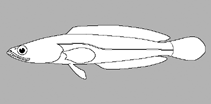
Raggi dorsali molli (totale) : 36 - 39; Raggi anali molli: 24 - 26; Vertebre: 49. This species is distinguished from all its congeners by the following characters: body uniform bright blue to bluish-green, bright-blue dorsal, anal, and caudal fins, submarginally black with white distal margin, series of brown to maroon-red, rounded, oblong or clover-shaped blotches or spots on dorsolateral, postorbital, and ventrolateral region of head, continued on body forming oblique pattern or randomly distributed; similar to C. pardalis and C. bipuli in appearance, but differs from both in having brown to maroon-red, rounded, oblong or clover-shaped blotches or spots on head and sides of the body (vs. possession of well-defined, black to brown, rounded to oblong spots), fewer pre-dorsal scales 7 (vs. 8–9), more caudal-fin rays 15 (vs. 13), and more vertebrae 49 (vs. 45) (Ref. 131046).
Cross section: oval.
Known from the streams at Puriang, East Khasi Hills, Meghalaya, where the habitat is a clear, slow-flowing hill stream, having rocky substrate, and Eriocaulon sp. as the only aquatic vegetation. Water temperature is18C at the time of survey. .Associated species in the habitat were C. lipor, Danio meghalayensis, and Tor sp. The species is shy in nature, hides in crevices among the submerged rocky boulders. It comes out only for feeding. Well-conditioned specimens when housed in water temperature less than 20C acquires a uniform bright blue body color with maroon-red blotches on the lateral body and immediately takes up golden-green to greenish-gray color when stressed or housed in warm temperature (Ref. 131046).
Ciclo vitale e comportamento di accoppiamento
Maturità | Riproduzione | Deposizione | Uova | Fecondità | Larve
Praveenraj, J., T. Thackeray, S.G. Singh, A. Uma, N. Moulitharan and B.K. Mukhim, 2020. A new species of snakehead (Teleostei: Channidae) from East Khasi Hills, Meghalaya, northeastern India. Copeia 108(4):938-947. (Ref. 131046)
Stato della Lista Rossa IUCN (Ref. 130435: Version 2025-2 (Global))
Minaccia per l'uomo
Harmless
Usi umani
Strumenti
Rapporti speciali
Scarica XML
Fonti Internet
Stime basate su modelli
Indice di diversità filogenetica (Fonte Biblio.
82804): PD
50 = 0.5000 [Uniqueness, from 0.5 = low to 2.0 = high].
Bayesian length-weight: a=0.00813 (0.00372 - 0.01775), b=2.98 (2.81 - 3.15), in cm total length, based on LWR estimates for this Genus-body shape (Ref.
93245).
Livello trofico (Fonte Biblio.
69278): 3.7 ±0.6 se; based on size and trophs of closest relatives
Resilienza (Fonte Biblio.
120179): Alto, tempo minimo di raddoppiamento della popolazione meno di 15 mesi (Preliminary K or Fecundity.).
Vulnerabilità della pesca (Ref.
59153): Low vulnerability (10 of 100).
🛈