>
Perciformes/Notothenioidei (Icefishes) >
Nototheniidae (Cod icefishes) > Trematominae
Etymology: Trematomus: Greek, trematos = hole + Greek, tomo = section, cut (Ref. 45335); pennellii: Species name pennellii honors Harry LL Pennell, captain of the ship Terra Nova of Scott's British Antarctic Expedition of 1910 (Ref. 45168).
Eponymy: Commander Harry Lewin Lee Pennell, R.N. (1882–1916) served (as Navigator, at the time he was a Lieutenant) on the ‘Terra Nova’, British Antarctic Expedition (1910–1913). He died during the Battle of Jutland. (Ref. 128868), visit book page.
More on author: Regan.
Taxonomic Remarks
The genus Pseudotrematomus is a synonym of Trematomus, which is confirmed by a molecular study to be published (J.-C. Hureau, pers. comm. 08 Jun. 2010). The species Pseudotrematomus centronotus (Regan, 1914) is recognised as valid.
Environnement : milieu / zone climatique / profondeur / gamme de distribution
Écologie
marin démersal; profondeur 0 - 732 m, usually 1 - 112 m (Ref. 11892). Polar; 60°S - 78°S
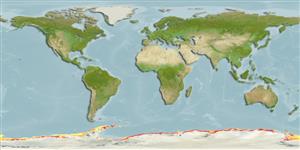
Southern Ocean: Scotia Arc, South Orkney Islands, Davis and Ross seas.
Taille / Poids / Âge
Maturité: Lm ? range ? - ? cm
Max length : 29.7 cm TL mâle / non sexé; (Ref. 124149); 26.0 cm TL (female); poids max. publié: 342.00 g (Ref. 124149); poids max. publié: 342.00 g
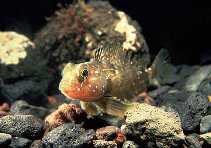
Épines dorsales (Total) : 4 - 6; Rayons mous dorsaux (Total) : 32 - 35; Rayons mous anaux: 29 - 31. Brownish with 2 or 3 large dark spots, part of spinous dorsal blackish (Ref. 11892).
Body shape (shape guide): fusiform / normal.
Adults live on seafloor and spawns during summer (Ref. 45168). They feed primarily on errant polychaetes, with lesser amounts of amphipods, fish eggs and mollusks.
Dewitt, H.H., P.C. Heemstra and O. Gon, 1990. Nototheniidae. p. 279-331. In O. Gon and P.C. Heemstra (eds.) Fishes of the Southern Ocean. J.L.B. Smith Institute of Ichthyology, Grahamstown, South Africa. (Ref. 5179)
Statut dans la liste rouge de l'IUCN (Ref. 130435: Version 2025-2 (Global))
Menace pour l'homme
Harmless
Utilisations par l'homme
Pêcheries: sans intérêt
Outils
Articles particuliers
Télécharger en XML
Sources Internet
Estimations basées sur des modèles
Température préférée (Réf.
123201): -1.8 - -1.1, mean -1.7 °C (based on 740 cells).
Indice de diversité phylogénétique (Réf.
82804): PD
50 = 0.5001 [Uniqueness, from 0.5 = low to 2.0 = high].
Bayesian length-weight: a=0.00550 (0.00367 - 0.00823), b=3.26 (3.14 - 3.38), in cm total length, based on LWR estimates for this species & Genus-body shape (Ref.
93245).
Niveau trophique (Réf.
69278): 3.3 ±0.2 se; based on diet studies.
Résilience (Réf.
120179): Milieu, temps minimum de doublement de population : 1,4 à 4,4 années (Fec = 2,500-6,600).
Vulnérabilité de la pêche (Ref.
59153): High vulnerability (63 of 100).
🛈
Nutriments (Ref.
124155): Calcium = 27.8 [14.3, 75.3] mg/100g; Iron = 0.418 [0.183, 0.866] mg/100g; Protein = 17 [16, 18] %; Omega3 = 0.389 [0.199, 0.723] g/100g; Selenium = 14.2 [5.5, 40.4] μg/100g; VitaminA = 23.3 [4.5, 125.4] μg/100g; Zinc = 0.641 [0.397, 1.022] mg/100g (wet weight); based on
nutrient studies.