>
Perciformes/Notothenioidei (Icefishes) >
Nototheniidae (Cod icefishes) > Trematominae
Etymology: Trematomus: Greek, trematos = hole + Greek, tomo = section, cut (Ref. 45335); nicolai: Named after Nicolai Hanson, biologist and collector of Southern Cross fishes, died at Cape Adare during the expedition (Ref. 11892).
Eponymy: Nicolai Hanson (1870–1899) was a Norwegian zoologist and Antarctic explorer. (See Hanson) (Ref. 128868), visit book page.
More on author: Boulenger.
Taxonomic Remarks
The genus Pseudotrematomus is a synonym of Trematomus, which is confirmed by a molecular study to be published (J.-C. Hureau, pers. comm. 08 Jun. 2010).
Environnement : milieu / zone climatique / profondeur / gamme de distribution
Écologie
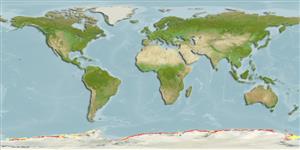
marin démersal; profondeur 1 - 420 m (Ref. 11892). Polar; 65°S - 78°S
Southern Ocean: East Antarctica (some localities), but not from the Peninsula region and westward to the Ross Sea. Coasts of Adelie Land, Davis, Weddell, South Shetland and South Orkney Islands.
Taille / Poids / Âge
Maturité: Lm ? range ? - ? cm
Deprecated: number_format(): Passing null to parameter #1 ($num) of type float is deprecated in /var/www/html/includes/common.lib.php on line 1833
Max length : 36.0 cm TL mâle / non sexé; (Ref. 5179); poids max. publié: 0.00 g
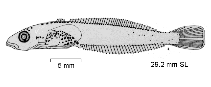
Épines dorsales (Total) : 4 - 5; Rayons mous anaux: 31 - 35. Body brownish, more or less distinct dark crossbars, scattered small dark spots, fins dusky, spiny dorsal blackish (Ref. 11892).
Body shape (shape guide): fusiform / normal.
A nearshore benthic species usually abundant in shelf waters of East Antartica (Ref. 122792). Adults feed primarily on amphipods, other fishes, and molluscan larvae, with lesser amount of polychaetes and mysids. They capture some prey in the water column, but are not cryopelagic.
Cycle de vie et comportement reproducteur
Maturité | Reproduction | Frai | Œufs | Fécondité | Larves
Dewitt, H.H., P.C. Heemstra and O. Gon, 1990. Nototheniidae. p. 279-331. In O. Gon and P.C. Heemstra (eds.) Fishes of the Southern Ocean. J.L.B. Smith Institute of Ichthyology, Grahamstown, South Africa. (Ref. 5179)
Statut dans la liste rouge de l'IUCN (Ref. 130435: Version 2025-2 (Global))
Menace pour l'homme
Harmless
Utilisations par l'homme
Pêcheries: sans intérêt
Outils
Articles particuliers
Télécharger en XML
Sources Internet
Estimations basées sur des modèles
Température préférée (Réf.
123201): -1.8 - -0.4, mean -1.4 °C (based on 382 cells).
Indice de diversité phylogénétique (Réf.
82804): PD
50 = 0.5001 [Uniqueness, from 0.5 = low to 2.0 = high].
Bayesian length-weight: a=0.00631 (0.00421 - 0.00945), b=3.21 (3.09 - 3.33), in cm total length, based on LWR estimates for this species & Genus-body shape (Ref.
93245).
Niveau trophique (Réf.
69278): 3.6 ±0.53 se; based on food items.
Generation time: 13.7 ( na - na) years. Estimated as median ln(3)/K based on 2
growth studies.
Résilience (Réf.
120179): Milieu, temps minimum de doublement de population : 1,4 à 4,4 années (Fec = 8,900).
Vulnérabilité de la pêche (Ref.
59153): Moderate to high vulnerability (51 of 100).
🛈