klasifikasi / Nama
Nama-nama umum | Sinonim (persamaan) | Catalog of Fishes(Marga, Jenis) | ITIS | CoL | WoRMS | Cloffa
>
Siluriformes (Catfishes) >
Mochokidae (Squeakers or upside-down catfishes) > Chiloglanidinae
Etymology: Chiloglanis: Greek, cheilos = lip + Greek, glanis = a fish that can eat the bait without touching the hook; a cat fish (Ref. 45335); carnatus: Name means fleshy, referring to the dermal tissue covering the base of the dorsal fin of some of the larger specimens and the general robust body structure of this species compared to its regional congeners.
Lingkungan: lingkungan / zona iklim / kisaran kedalaman / jangkauan distribusi
Ekologi
; air tawar bentopelagis. Tropical
Africa: Zimbabwe.
Ukuran / Berat / umur
Kematangan: Lm ? range ? - ? cm
Max length : 6.2 cm TL jantan/; (Ref. 130906); 5.6 cm TL (female)
deskripsi pendek
Kunci identifiaksi (pengenalan) | Morfologi | Morfometrik
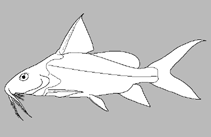
duri punggung lunak (Keseluruhan (total)) : 5 - 7; Sirip dubur lunak: 12 - 13. This species is distinguished from its congeners in southern Africa (i.e. anoterus, bifurcus, emarginatus, fasciatus, paratus, pretoriae, swierstrai) by the dorsal fin that has a basal portion covered by a fleshy skin, a character which is absent in the other species; with ten closely packed mandibular teeth; a deeply forked caudal fin, with an upper lobe that is shorter than the lower lobe; oral disc with a well-developed mid-ventral cleft; a smooth skin with a few tubercles occasionally found on the head; a dorsal spine with crenate anterior and posterior margins (Ref. 130906).
Cross section: angular.
TThe species was collected from Mukwadzi River, a perennial river that originates from wetlands (dambos) on the eastern side of the Great Dyke. This river flows in a north-western direction cutting through the Great Dyke before it joins the Manyame River. The substratum at the sites was composed of bedrock, cobbles and gravel, and the riparian vegetation was mainly Syzygium Gaertner, 1788 and Phragmites Adanson, 1763. It co-occurred with native fish species that include Labeo cylindricus Peters, 1852, Opsaridium zambezense (Peters, 1852), Enteromius trimaculatus (Peters, 1852), Tilapia sparrmanii Smith, 1840, Clarias gariepinus (Burchell, 1822), and Labeobarbus marequensis (Smith, 1841) as well as the non-native species Serranochromis jallae (Boulenger, 1896) and Micropterus salmoides (Lacepède, 1802) (Ref. 130906).
Siklus hidup dan perilaku kawin
Kematangan | Reproduksi, perkembang biakan | Pemijahan | telur-telur | Fekunditas | Larva
Mutizwa, T.I., W.T. Kadye, P.H.N. Bragança, T. Bere and A. Chakona, 2024. Hidden in the riffles: a new suckermouth catfish (Mochokidae,Chiloglanis) from the middle Zambezi River system, Zimbabwe. ZooKeys 1197:57-91. (Ref. 130906)
Status IUCN Red List (Ref. 130435: Version 2025-2 (Global))
ancaman kepada manusia
Harmless
penggunaan manusia
Perikanan: tidak ada kepentingan
Alat, peralatan
laporan khas
muat turun XML
Sumber internet
Estimasi berdasarkan model
Indeks keanekaragaman filogenetik (Acuan
82804): PD
50 = 0.5000 [Uniqueness, from 0.5 = low to 2.0 = high].
Bayesian length-weight: a=0.00389 (0.00180 - 0.00842), b=3.12 (2.94 - 3.30), in cm total length, based on all LWR estimates for this body shape (Ref.
93245).
Tingkat Trofik (Acuan
69278): 3.2 ±0.4 se; based on size and trophs of closest relatives
Daya lenting (Acuan
120179): Tinggi, Waktu penggandaan populasi minimum kurang dari 15 bulan (Preliminary K or Fecundity.).
Kerentanan Penangkapan Ikan (Ref.
59153): Low vulnerability (10 of 100).
🛈