Classificatie / Namen
Lokale namen | Synoniemen | Catalog of Fishes(Genus, Soort(en)) | ITIS | CoL | WoRMS | Cloffa
>
Siluriformes (Catfishes) >
Loricariidae (Armored catfishes) > Hypoptopomatinae
Etymology: Curculionichthys: Derived from the from the Latin 'curculionem' (elongated snout) and from the Greek 'ichthys' (fishes), in reference to the relatively elongated snouts of the fish species included in this genus; monolechis: Name from the Greek word 'monos' meaning one or single, and 'lekos' for plate, referring to the single rostral plate; noun in apposition.
Milieu: milieu / Klimaatzone / Diepte / verspreidingsgebied
Ecologie
; zoet water demersaal. Tropical
South America: Suriname and French Guiana.
Grootte / Gewicht / Leeftijd
Maturiteit: Lm ? range ? - ? cm
Max length : 2.3 cm SL mannelijk / geslacht onbekend; (Ref. 130866)
Korte beschrijving
Determinatiesleutels | Morfologie | Morfometrie
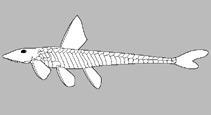
Wervels: 29. This species is distinguished from its congeners by having the following characters: rostral plate single (vs. paired, but variably single in insperatus, luteofrenatus, oliveirai, karipuna); differs from its congeners (except luteofrenatus, piracanjuba, scaius) by having more numerous premaxillary teeth, 20-28 (vs. 6-19) and (except with luteofrenatus, scaius)
with more numerous dentary teeth, 19-25 (vs. 4-18); differs from luteofrenatus, coxipone by having fewer plates in median lateral series, 22-24 (vs. 25-27), from oliveirai, paresi by having more numerous lateral abdominal plates, 6-8 (vs. 4-5 and 4-6, respectively); further differs from insperatus, sabaji, sagarana by having a single series of large median ventral plates (vs. usually three or more regular series of median ventral plates, or small plates irregularly distributed); differs from piracanjuba, scaius by having a longer caudal penduncle, 27.0-31.6% SL (vs. 20.6-25.0 and 25.4-26.8% SL, respectively) and from luteofrenatus, oliveirai by having narrower cleithral width, 22.3-23.7% SL (vs. 23.-25.2 and 23.8-26.8% SL, respectively); further diagnosed from the geographically closer species C. karipuna, by having a shorter head, 29.2-35% SL (vs. 36.4-44.1% HL), larger suborbital depth, 23.0-26.1% HL (vs. 13.3-22.9% HL), total vertebrae 29 (vs. 27-28), more numerous premaxillary teeth 20-28 (vs. 11-17), and at least 5% genetic distance in gene coI (Ref. 130866).
This species was collected in rivers and small- to medium-sized rainforest creeks in areas of rocky rapids and sandbanks. The extinction risk of this species is estimated to be low despite incomplete knowledge of its populational trends and geographic distribution. The species is known from at least 16 localities in the Saramacca River of Suriname and the Marowijne
(¼Maroni) in Suriname and French Guiana, with an estimated Extension of Occurrence (EOO) of 56,513 km2, based on the minimum convex polygon around known localities. It seems to be abundant and despite logging and gold mining being widespread in the area, no specific threats were identified in the region, which is largely forested. Thus, for these reasons, this species is tentatively categorized as Least Concern (LC) according to the IUCN categories and criteria
(IUCN Standards and Petitions Subcommittee, 2019) (Ref. 130866).
Levenscyclus en paargedrag
Maturiteit | Voortplanting | Paaien | Eieren | Fecunditeit | Larven
Morais, A. de, S.P. Gamarra and R.E. Reis, 2024. A new species of Curculionichthys (Siluriformes: Loricariidae) from the Saramacca and Marowijne River basins, Suriname and French Guiana. Ichthyology & Herpetology 112(1):60-68. (Ref. 130866)
Status op de Rode Lijst van het IUCN (Ref. 130435: Version 2025-2 (Global))
Gevaar voor de mens
Harmless
Gebruik door de mens
Visserij: van geen belang
Tools
Speciale rapporten
Download XML
Internetbronnen
Schattingen op basis van modellen
Fylogenetische diversiteitsindex (Ref.
82804): PD
50 = 0.5001 [Uniqueness, from 0.5 = low to 2.0 = high].
Bayesian length-weight: a=0.00977 (0.00434 - 0.02202), b=3.06 (2.87 - 3.25), in cm total length, based on LWR estimates for this (Sub)family-body shape (Ref.
93245).
Trofisch niveau (Ref.
69278): 2.7 ±0.1 se; based on size and trophs of closest relatives
Weerstandsvermogen (Ref.
120179): Hoog, minimale populatieverdubbelingstijd minder dan 15 maanden (Preliminary K or Fecundity.).
Kwetsbaarheid van de visserij (Ref.
59153): Low vulnerability (10 of 100).
🛈