>
Perciformes/Notothenioidei (Icefishes) >
Nototheniidae (Cod icefishes) > Trematominae
Etymology: Trematomus: Greek, trematos = hole + Greek, tomo = section, cut (Ref. 45335); bernacchii: Species name bernacchii honors Louis Bernarcchi, an Australian physicist-meteorologist; specimen collected on the Southern Cross Expedition and served on Scott's 1901 expedition (Ref. 45168).
Eponymy: Louis Charles ‘Bunny’ Bernacchi (1876–1942) was a physicist and astronomer who took part in several expeditions to Antarctica. [...] (Ref. 128868), visit book page.
More on author: Boulenger.
Taxonomic Remarks
The genus Pseudotrematomus is a synonym of Trematomus, which is confirmed by a molecular study to be published (J.-C. Hureau, pers. comm. 08 Jun. 2010).
Entorno: milieu / zona climática / rango de profundidad / gama de distribución
Ecología
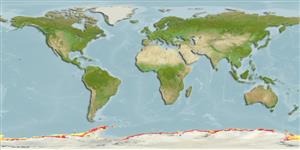
marino demersal; rango de profundidad 0 - 700 m (Ref. 11892), usually 0 - 200 m (Ref. 45168). Polar; 61°S - 78°S
Southern Ocean: Peter Island, South Shetland, Elephant and South Orkney islands. Mac-Robertson, Queen Mary, Adelie Coasts, Weddell, Davis and Ross seas. East Antarctica from Queen Maud Land to Terre Adelie.
Longitud en la primera madurez / Tamaño / Peso / Edad
Madurez: Lm ?, range 18 - ? cm
Max length : 28.0 cm TL macho / no sexado; (Ref. 5179); 35.0 cm TL (female); common length : 25.0 cm TL macho / no sexado; (Ref. 2121); edad máxima reportada: 10 años (Ref. 5179)
Descripción breve
Claves de identificación | Morfología | Morfometría
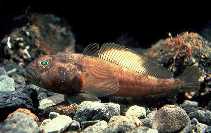
Espinas dorsales (total) : 4 - 6; Radios blandos dorsales (total) : 34 - 39; Radios blandos anales: 31 - 35. Body brownish, large dark spots in two or three series on body. Spinous dorsal blackish in upper part (Ref. 11892).
Body shape (shape guide): fusiform / normal.
Found in seafloors, well adapted to extremely low and stable temperatures (-1.86°C), annual mean temperature of McMurdo Sound) (Ref. 45168). Feed on polychaetes, gastropods, isopods, amphipods and few algae. Spawn once a year (Ref. 1071). Utilized for human consumption.
Although members of this Family are known to tend to egg masses, it is assumed that because of the high fecundity, this species is a non-guarder (RF), to be corrected if direct information becomes available.
Dewitt, H.H., P.C. Heemstra and O. Gon, 1990. Nototheniidae. p. 279-331. In O. Gon and P.C. Heemstra (eds.) Fishes of the Southern Ocean. J.L.B. Smith Institute of Ichthyology, Grahamstown, South Africa. (Ref. 5179)
Situación en la Lista Roja de la UICN (Ref. 130435: Version 2025-2 (Global))
Amenaza para el ser humano
Harmless
Usos humanos
Pesquerías: comercial
Herramientas
Informes especiales
Descargar XML
Fuentes de Internet
Estimaciones basadas en modelos
Temperatura preferida (Referencia
123201): -1.8 - -0.8, mean -1.7 °C (based on 2076 cells).
Índice de diversidad filogenética (Referencia
82804): PD
50 = 0.5001 [Uniqueness, from 0.5 = low to 2.0 = high].
Bayesian length-weight: a=0.00537 (0.00282 - 0.01024), b=3.24 (3.07 - 3.41), in cm total length, based on LWR estimates for this Genus-body shape (Ref.
93245).
Nivel trófico (Referencia
69278): 3.4 ±0.1 se; based on diet studies.
Generation time: 5.9 (2.0 - 12.2) years. Estimated as median ln(3)/K based on 11
growth studies.
Resiliencia (Referencia
120179): Medio, población duplicada en un tiempo mínimo de 1.4-4.4 años (K=0.19-0.91; tm=3-6; tmax=10; Fec=1,200-3,123).
Vulnerabilidad pesquera (Ref.
59153): Moderate to high vulnerability (53 of 100).
🛈
Nutrientes (Ref.
124155): Calcium = 31.4 [18.6, 70.0] mg/100g; Iron = 0.456 [0.206, 0.860] mg/100g; Protein = 17.3 [16.3, 18.4] %; Omega3 = 0.417 [0.228, 0.727] g/100g; Selenium = 15.4 [6.7, 32.6] μg/100g; VitaminA = 15.6 [3.5, 70.7] μg/100g; Zinc = 0.515 [0.356, 0.761] mg/100g (wet weight); based on
nutrient studies.