klasifikasi / Nama
Nama-nama umum | Sinonim (persamaan) | Catalog of Fishes(Marga, Jenis) | ITIS | CoL | WoRMS | Cloffa
>
Siluriformes (Catfishes) >
Pseudopimelodidae (Bumblebee catfishes, dwarf marbled catfishes) > Batrochoglaninae
Etymology: Microglanis: Greek, mikros = small + Greek, glanis = a fish that can eat the bait without touching the hook; a cat fish (Ref. 45335).
Eponymy: The Xerente ethnic group are the native indigenous people who live along the Rio Tocantins basin, Brazil. (Ref. 128868), visit book page.
Lingkungan: lingkungan / zona iklim / kisaran kedalaman / jangkauan distribusi
Ekologi
; air tawar dasar (demersal). Tropical
South America: Brazil.
Ukuran / Berat / umur
Kematangan: Lm ? range ? - ? cm
Max length : 2.7 cm SL jantan/; (Ref. 130492)
deskripsi pendek
Kunci identifiaksi (pengenalan) | Morfologi | Morfometrik
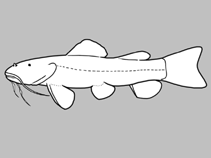
Duri punggung (Keseluruhan (total)) : 2; duri punggung lunak (Keseluruhan (total)) : 6; Sirip dubur lunak: 11 - 12. This species is distinguished from its congeners by the following characters: with a wide brown stripe in the dorsal and caudal fins in specimens larger than 2.5 cm SL (inconspicuous or absent in small specimens) and by the presence of neuromasts surrounded by melanophores forming small black dots aligned in four rows on head, one on nape, one posterior to nape, and three horizontal on trunk; differs further by the presence or absence of a light band on nape (some paratypes have a small and irregular pale brown blotch on the region nuchal), supraoccipital process not contacting the anterior nuchal plate, width of mouth 34-47% HL (vs. 47-63 in M. carlae, M. cibelae, M. cottoides, M. iheringi, M. malabarbai, M. minutus, M. reikoae, M. nigripinnis, M. oliveirai, M. parahybae, M. pataxo, M. pleriqueater, M. sparsus, M. variegatus), and greater caudal peduncle length 15.9-17.9% SL (vs. 10.0-15.9 in M. carlae, M. cibelae, M. cottoides, M. eurystoma, M. iheringi, M. maculatus, M. malabarbai, M. nigripinnis, M. parahybae, M. pataxo, M. pellopterygius, M. poecilus, M. secundus, M. variegatus) (Ref. 130492).
Cross section: oval.
The specimens of were collected from small watercourses draining the Cerrado biome, with riparian forest relatively well preserved and usually with buriti palm trees (Mauritia flexuosa) present on the margins of the stream and around these watercourses, there are usually livestock pastures. At the córrego Narciso, there are small rapids, sandy patches, and pools, usually presenting leaves, fallen tree branches, and submerged leaf-litter at the bottom (Ref. 130492).
Siklus hidup dan perilaku kawin
Kematangan | Reproduksi, perkembang biakan | Pemijahan | telur-telur | Fekunditas | Larva
Ruiz, W.B.G., 2016. Three new species of catfishes of the genus Microglanis from Brazil (Teleostei: Pseudopimelodidae), with comments on the characters used within the genus. Ichthyol. Explor. Freshwat. 27(3):211-232. [22 Nov. 2016 is the publication date without ZooBank registration, 18 Nov. with an electronic prepublication date; this serves as the date for Oct., Nov. and Dec.] (Ref. 130492)
Status IUCN Red List (Ref. 130435: Version 2025-2 (Global))
ancaman kepada manusia
Harmless
penggunaan manusia
Alat, peralatan
laporan khas
muat turun XML
Sumber internet
Estimasi berdasarkan model
Indeks keanekaragaman filogenetik (Acuan
82804): PD
50 = 0.5000 [Uniqueness, from 0.5 = low to 2.0 = high].
Bayesian length-weight: a=0.00692 (0.00292 - 0.01638), b=3.12 (2.91 - 3.33), in cm total length, based on LWR estimates for this (Sub)family-body shape (Ref.
93245).
Tingkat Trofik (Acuan
69278): 3.2 ±0.4 se; based on size and trophs of closest relatives
Kerentanan Penangkapan Ikan (Ref.
59153): Low vulnerability (10 of 100).
🛈