>
Blenniiformes (Blennies) >
Blenniidae (Combtooth blennies) > Salariinae
Etymology: Cirripectes: Latin, cirrus = curl fringe + Greek, pektos, -e, -on = made of several parts solidly united (Ref. 45335); matatakaro: Name from i-Kiribati words ‘‘mata’’ (eye) and ‘‘takaro’’ (ember/burning coal), referring to the large, eager-seeming eyes and the red slashes on the face resembling to smoldering embers or burning coals. Named in the i-Kiribati language to honor the people and culture of Kiribati, where the first author first encountered and collected the new species.
Meio ambiente: milieu / Zona climática / intervalo de profundidade / faixa de distribuição
Ecologia
marinhas associadas(os) a recifes; intervalo de profundidade 10 - 32 m (Ref. 123088). Tropical
Central Pacific: Marquesas, Gambier, Pitcairns, Tuamotus, and Austral Is., and the Northern Line Islands and possibly Johnston Atoll, south of Hawai‘i.
Tamanho / Peso / Idade
Maturidade: Lm ? range ? - ? cm
Max length : 5.8 cm SL macho/indeterminado; (Ref. 123088); 6.4 cm SL (female)
Descrição suscinta
Chaves de identificação | Morfologia | Morfometria
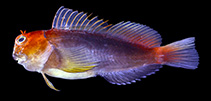
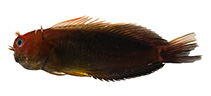
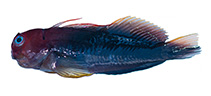
Espinhos dorsais (total) : 12; Raios dorsais (total) : 14; Espinhos anais: 2; Raios anais : 15; Vértebras: 30. This species is distinguished from its congeners by the following set of characters: male genital papilla with two widely separated slender filaments to either side of the gonopore, type I sensu Williams (1988); nuchal cirri is divided into two, rarely three or four, groups always slightly separated dorsally on nape with bases swollen beneath ventralmost cirri on either side; overall shape of the transverse row of nuchal cirri modally type I and sometimes type II (types C and G sensu Williams), with 32-38 independently based cirri; dorsal separation in row of nuchal cirri 0.1-0.7 mm (median width 0.3 mm); where interrupted laterally, lateral breaks in the row of nuchal cirri 0-0.4 mm in width (median width 0 mm); sensory pore structure is directly posterior to lateral center of row of nuchal cirri type I, posterior and parallel to row of nuchal cirri, does not visibly penetrate through break (where present); 0-6 distinct LLT. Colouration: when alive, head commonly bright reddish orange on upper section with bright red spots and/or slashes extending dorsally and posteriorly from the snout and the outer ring of iris bright orange-red (Ref. 123088).
Cross section: oval.
Ciclo de vida ou comportamento de acasalamento
Maturidade | Reprodução | Desova | Ovos | Fecundidade | Larvas
Hoban, M.L. and J.T. Williams, 2020. Cirripectes matatakaro, a new species of combtooth blenny from the Central Pacific, illuminates the origins of the Hawaiian fish fauna. PeerJ 8(e8852):1-27. (Ref. 123088)
Status na Lista Vermelha da UICN (Ref. 130435: Version 2025-2 (Global))
Ameaça para os humanos
Harmless
Uso pelos humanos
Ferramentas
Relatórios especiais
Baixar XML
Fontes da internet
Estimativas baseadas em modelos
Índice de diversidade filogenética (Ref.
82804): PD
50 = 0.5000 [Uniqueness, from 0.5 = low to 2.0 = high].
Bayesian length-weight: a=0.01047 (0.00463 - 0.02370), b=2.98 (2.79 - 3.17), in cm total length, based on LWR estimates for this (Sub)family-body shape (Ref.
93245).
Resiliência (Ref.
120179): Elevada, tempo mínimo de duplicação da população menor que 15 meses (Preliminary K or Fecundity.).
Vulnerabilidade da pesca (Ref.
59153): Low vulnerability (10 of 100).
🛈