>
Ovalentaria/misc (Various families in series Ovalentaria) >
Opistognathidae (Jawfishes)
Etymology: Opistognathus: Greek, opisthe = behind + Greek, gnathos = jaw (Ref. 45335); to the very elongate upper jaw of the type species of the genus, Opistognathus nigromarginatus (Ref. 128653).
Entorno: milieu / zona climática / rango de profundidad / gama de distribución
Ecología
marino asociado a arrecife; rango de profundidad 10 - 25 m (Ref. 129348). Tropical
Southwest Atlantic Ocean: Brazil.
Tamaño / Peso / Edad
Madurez: Lm ? range ? - ? cm
Max length : 4.7 cm SL macho / no sexado; (Ref. 129348)
Descripción breve
Claves de identificación | Morfología | Morfometría
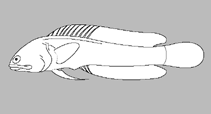
Espinas dorsales (total) : 11; Radios blandos dorsales (total) : 14; Espinas anales: 2 - 3; Radios blandos anales: 12 - 13; Vértebra: 27. This species is distinguished by the following set of characters: anterior nostril is a short tube with simple cirrus on posterior rim; maxilla rigid, not produced as a thin flexible lamina posteriorly; no supramaxilla; subopercle without a broad, fan-like flap; vomer no teeth; body with 43-47 oblique body scale rows in longitudinal series; vertebrae 10 + 17 = 27. Colouration: sides with two rows of pale spots, each approximately diameter of eye; body with six vertically irregular, evenly spaced bands, widest on mid-side, and two rows of six pale spots, each spot approximately diameter of eye; buccal area surrounding esophageal opening is pale. Also easily disinguished from its congeners by the divergence in the mitochondrial gene COI, as specimens form a monophyletic group that differs from its closest relative (O. whitehursti) by an
average of 11% (654 bp analyzed) (Ref. 129348).
Cross section: oval.
This species is common in coastal regions, in depths associated with gravel-sand bottoms, near coral reefs and rocky areas. Feeds mainly on small benthic organisms near the bottom (e.g., small shrimps, crabs, and isopods) (Ref. 129348).
Ciclo vital y comportamiento de apareamiento
Madurez | Reproducción | Puesta | Huevos | Fecundidad | Larva
Smith-Vaniz, W.F,, L. Tornabene and R.M. Macieira, 2018. Review of Brazilian jawfishes of the genus Opistognathus with descriptions of two new species (Teleostei, Opistognathidae). ZooKeys No. 794: 95-133. (Ref. 129348)
Situación en la Lista Roja de la UICN (Ref. 130435: Version 2025-2 (Global))
Amenaza para el ser humano
Harmless
Usos humanos
Herramientas
Informes especiales
Descargar XML
Fuentes de Internet
Estimaciones basadas en modelos
Índice de diversidad filogenética (Referencia
82804): PD
50 = 0.5000 [Uniqueness, from 0.5 = low to 2.0 = high].
Bayesian length-weight: a=0.00389 (0.00180 - 0.00842), b=3.12 (2.94 - 3.30), in cm total length, based on all LWR estimates for this body shape (Ref.
93245).
Nivel trófico (Referencia
69278): 3.3 ±0.5 se; based on size and trophs of closest relatives
Vulnerabilidad pesquera (Ref.
59153): Low vulnerability (10 of 100).
🛈