Classificação / Nomes
Nomes comuns | Sinónimos | Catalog of Fishes(Género, Espécies) | ITIS | CoL | WoRMS | Cloffa
>
Gobiiformes (Gobies) >
Schindleriidae (Infantfishes)
Etymology: Schindleria: Named for ichthyologist Otto Schindler, 1906-1959 (Prof. Dr. Konrad Schindler, pers. comm Dec. 2017); edentata: Name from Latin 'e' from without, and 'dentatus' = toothed, referrinf to the absence of teeth in both jaws; an adjective.
Eponymy: Otto Schindler (1906–1959) was an ichthyologist at Zoologische Staatssammlung München, Germany, where he was the first post-war Curator of Ichthyology (1949). [...] (Ref. 128868), visit book page.
Ambiente: milieu / zona climática / intervalo de profundidade / gama de distribuição
Ecologia
marinhas associadas(os) a recifes; intervalo de profundidade 1 - 7 m (Ref. 129305). Tropical
Western Indian Ocean: Red Sea, Egypt.
Tamanho / Peso / Idade
Maturidade: Lm ? range ? - ? cm
Max length : 10.0 cm TL macho/indeterminado; (Ref. 129305)
Descrição breve
Chaves de identificação | Morfologia | Morfometria
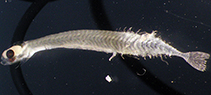
Raios dorsais moles (total) : 15; Raios anais moles: 13. This species belonging to the short dorsal-fin type of Schindleria, with the dorsal and anal fins of about equal length is characterized by the following: body elongated but relatively deep (body depth at anal-fin origin 10.8% of SL and at 4th anal-fin ray 10.9 % of SL); the short dorsal fin originates just slightly anterior to the anal fin (predorsal-fin length 60.9% of SL, pre-anal fin length 64.8% of SL); head stubby with a steep frontal profile, snout short, 23.1% of head length, eye large, 27.7% of the HL; pectoral radial plate long, its length 7.6% of SL; four dorsal and four ventral procurrent caudal-fin rays with increasing in length posteriorly, its last procurrent ray simple without additional spine and, although the longest, not distinctly elongate; D 15, A 13; base of first anal-fin ray positioned below the base of the third dorsal-fin ray; upper and lower jaws no teeth; in vivo with translucent body; eye black; swim bladder capped by a melanophore blotch; no pigmentation externally on body after preservation (Ref. 129305).
Cross section: compressed.
Collected at a depth of one meter from a lagoon with sandy bottom and covered with algae and seagrass (Ref. 129305).
Ciclo de vida e comportamento de acasalamento
Maturidade | Reprodução | Desova | Ovos | Fecundidade | Larvas
Ahnelt, H., V, Robitzch and M. Abu El-Regal, 2022. A new species of toothless, short dorsal-fin Schindleria (Gobiiformes: Gobiidae) from the Red Sea (Egypt). Vertebrate Zoology v. 72: 551-559. (Ref. 129305)
Categoria na Lista Vermelha da IUCN (Ref. 130435: Version 2025-2 (Global))
Ameaça para o homem
Harmless
Utilização humana
Pescarias: sem interesse
Ferramentas
Relatórios especiais
Descarregue XML
Fontes da internet
Estimativas baseadas em modelos
Índice de diversidade filogenética (Ref.
82804): PD
50 = 0.5005 [Uniqueness, from 0.5 = low to 2.0 = high].
Bayesian length-weight: a=0.00389 (0.00180 - 0.00842), b=3.12 (2.94 - 3.30), in cm total length, based on all LWR estimates for this body shape (Ref.
93245).
Nível Trófico (Ref.
69278): 3.3 ±0.4 se; based on size and trophs of closest relatives
Vulnerabilidade da pesca (Ref.
59153): Low vulnerability (10 of 100).
🛈