Classificação / Nomes
Nomes comuns | Sinónimos | Catalog of Fishes(Género, Espécies) | ITIS | CoL | WoRMS | Cloffa
>
Cyprinodontiformes (Rivulines, killifishes and live bearers) >
Rivulidae (Rivulines) > Cynolebiinae
Etymology: guarani: Named for the Guaraní indigenous people, who live in several settlements very close to the type locality of this species, as a vindication of their culture and history.
Ambiente: milieu / zona climática / intervalo de profundidade / gama de distribuição
Ecologia
; Água doce pelágico(a,os,as); intervalo de profundidade 0 - 1 m (Ref. 129129). Tropical
South America: Argentina.
Tamanho / Peso / Idade
Maturidade: Lm ? range ? - ? cm
Max length : 5.5 cm SL macho/indeterminado; (Ref. 129129); 3.8 cm SL (female)
Descrição breve
Chaves de identificação | Morfologia | Morfometria
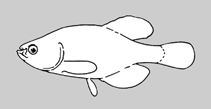
This species is distinguished from its congeners by having a unique colour pattern consisting of the following: mature males when alive with scattered small dark brown to grey irregular blotches on the laterodorsal surface of head and anterior portion of trunk, with many and relatively big sub-square irregular iridescent turquoise to light blue blotches on unpaired fins, evenly distributed, and those in the distal portion are elongated and merging, the trunk and tail with anterocentral part of scales iridescent turquoise with grey borders generating a reticulated pattern, the thin external border of the scales in the dorsal part of trunk, below the dorsal fin, are iridescent turquoise, and orange-yellowish background coloration on the base of unpaired fins and yellowish belly; in juveniles and young adults, anterior nostrils are ventrolaterally directed (Ref. 129129).
Body shape (shape guide): elongated; Cross section: compressed.
Found only in its type locality which is a seasonal pond, mainly covered with grass, in the Paraná Forest at ca.185 m a.s.l.. It is in an open space, in the surrounding jungle, with abundant palm trees. Maximum depth measured was ca. 80 cm, and the water was clear and no submerged aquatic vegetation was observed. The bottom is of soft sediment, with abundant organic
matter (Ref. 129129).
Ciclo de vida e comportamento de acasalamento
Maturidade | Reprodução | Desova | Ovos | Fecundidade | Larvas
Alonso, F., G.E. Terán, W.S. Serra Alanís, P. Calviño, M.M. Montes, I.D. García, J.A. Barneche, A. Almirón, L. Ciotek, P. Giorgis and J. Casciotta, 2023. From the mud to the tree: phylogeny of Austrolebias killifishes, new generic structure and description of a new species (Cyprinodontiformes: Rivulidae). Zool. J. Linn. Soc. 199:280-309. (Ref. 129129)
Categoria na Lista Vermelha da IUCN (Ref. 130435: Version 2025-2 (Global))
Ameaça para o homem
Harmless
Utilização humana
Pescarias: sem interesse
Ferramentas
Relatórios especiais
Descarregue XML
Fontes da internet
Estimativas baseadas em modelos
Índice de diversidade filogenética (Ref.
82804): PD
50 = 0.5625 [Uniqueness, from 0.5 = low to 2.0 = high].
Bayesian length-weight: a=0.00617 (0.00266 - 0.01427), b=3.13 (2.93 - 3.33), in cm total length, based on LWR estimates for this (Sub)family-body shape (Ref.
93245).
Nível Trófico (Ref.
69278): 3.2 ±0.4 se; based on size and trophs of closest relatives
Resiliência (Ref.
120179): Elevada, tempo mínimo de duplicação da população menor que 15 meses (Preliminary K or Fecundity.).
Vulnerabilidade da pesca (Ref.
59153): Low vulnerability (10 of 100).
🛈