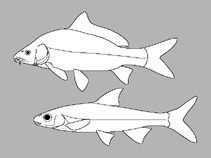
Classificazione / Nomi
Nomi Comuni | Sinonimi | Catalog of Fishes(Genere, Specie) | ITIS | CoL | WoRMS | Cloffa
>
Cypriniformes (Carps) >
Cyprinidae (Minnows or carps) > Labeoninae
Etymology: Garra: Name based on a vernacular Indian name (Hamilton, 1822:343, Ref. 1813); a fish living in mud (Ref. 128817); hormuzensis: Named for the Strait of Hormuz, a strait between the Persian Gulf and the Gulf of Oman; an adjective.
Ambiente: milieu / zona climatica / distribuzione batimetrica / gamma di distribuzione
Ecologia
; acqua dolce benthopelagico. Subtropical
Asia: Iran.
Dimensione / Peso / Età
Maturità: Lm ? range ? - ? cm
Max length : 5.3 cm SL maschio/sesso non determinato; (Ref. 128970)
Breve descrizione
Chiavi di identificazione | Morfologia | Morfometria
This species is distinguished from its congeners in the Persian Gulf basin by the following set of characters, none of them unique to the species: differs from G. mondica by having 3 (very rarely 2) scales between the anus and the anal-fin origin (vs. usually 2) and with chest covered by scales with free posterior margins (vs. scales fully embedded); differs from G. amirhosseini by having 3 (very rarely 2) scales between the anus and the anal-fin origin (vs. usually 2); differs from G. elegans by having free lateral and posterior margins of the gular disc (vs. fully attached); differs from G. gymnothorax, G. rufa by the branched dorsal-fin rays which is usually 7½ (vs. usually 8½); differs from G. gymnothorax with posterior margins of the scales on the chest and belly not embedded in the skin (vs. chest scaleless in some G. gymnothorax and scales fully embedded, with free posterior margins or chest scaleless in G. rufa ); differs from G. meymehensis by having scales with free posterior margins on the chest (vs. embedded); differs from G. tiam by branched dorsal-fin rays usually 7½ (vs. 8½), circumpeduncular scale rows 13-16 (vs. 12–13), and chest covered by scales (vs. chest scaleless); differs from G. persica by the caudal-fin rays usually 9+8 (vs. 8+8) (Ref. 128970).
Cross section: oval.
Found in Shur River where the dominant substrate type were cobble and boulder and the riparian vegetation were few bushes and trees (Ref. 128970).
Ciclo vitale e comportamento di accoppiamento
Maturità | Riproduzione | Deposizione | Uova | Fecondità | Larve
Zamani-Faradonbe, M., E. Zhang and Y. Keivany, 2021. Garra hormuzensis, a new species from the upper Kol River drainage in the Persian Gulf basin (Teleostei: Cyprinidae). Zootaxa 5052(3):380-394. (Ref. 128970)
Stato della Lista Rossa IUCN (Ref. 130435: Version 2025-2 (Global))
Minaccia per l'uomo
Harmless
Usi umani
Pesca: di nessun interesse
Strumenti
Rapporti speciali
Scarica XML
Fonti Internet
Stime basate su modelli
Indice di diversità filogenetica (Fonte Biblio.
82804): PD
50 = 0.5000 [Uniqueness, from 0.5 = low to 2.0 = high].
Bayesian length-weight: a=0.00794 (0.00359 - 0.01758), b=3.04 (2.87 - 3.21), in cm total length, based on LWR estimates for this Genus-body shape (Ref.
93245).
Resilienza (Fonte Biblio.
120179): Alto, tempo minimo di raddoppiamento della popolazione meno di 15 mesi (Preliminary K or Fecundity.).
Vulnerabilità della pesca (Ref.
59153): Low vulnerability (10 of 100).
🛈