>
Blenniiformes (Blennies) >
Chaenopsidae (Pike-, tube- and flagblennies)
Etymology: Emblemariopsis: Latin, emblema = insertion, inlaid work, raised ornament + Greek, opsis = appearance (Ref. 45335); falcon: Named for the Venezuelan state of Falcon, the location at which the species was first recognized by Jose Gregorio Rodríguez in 2008.
Lingkungan: lingkungan / zona iklim / kisaran kedalaman / jangkauan distribusi
Ekologi
laut bentopelagis; kisaran kedalaman 10 - 12 m (Ref. 125603). Tropical
Western Atlantic: Venezuela.
Ukuran / Berat / umur
Kematangan: Lm ? range ? - ? cm
Max length : 2.5 cm SL jantan/; (Ref. 125603)
deskripsi pendek
Kunci identifiaksi (pengenalan) | Morfologi | Morfometrik
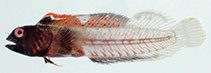
Duri punggung (Keseluruhan (total)) : 20 - 21; duri punggung lunak (Keseluruhan (total)) : 11 - 12; Duri dubur: 2; Sirip dubur lunak: 20 - 21. This species is distinguished by the following characters: with an orbital cirrus and a red banner (a set of 7 spp.); TP territorial males live in holes, with a black head and blackened anterior dorsal fin with a distal red band over a narrow white band and a thin white margin, the red band extending posteriorly to 5th-7th spinous membrane, curved down at front when erected in displaying TP, the narrow anterior flap variably present along first spine; with first 10 dorsal-fin spines relatively short and about equal length, the first spine reaching to 5th-6th spine base when adpressed, about half of HL, 11-12% SL; profile of anterior dorsal fin usually a straight line or slight concavity.
Colouration: TP dark-shaded and pale with a red-banded dorsal fin with irregular rows of larger dark spots along membranes of mid and posterior spinous-dorsal fin; the lower operculum and branchiostegal membranes with prominent narrow white lines alternating with wider rust-red or dark bands (= banded-operculum group of 3 spp.); row of discrete small dark spots along anterior lateral midline absent, uncommon with a row of dark spots along anterior upper body; transitional males have variably elongated anterior dorsal-fin spines with a distal red band over reticulated brown to orange bands on first three membranes.
IP with elongated first two dorsal-fin spines, often orange-tipped membranes, the first spine reaching to the base of 6th-9th spine base when adpressed, the second slightly shorter, third about 1/2 of first (earlier IP and juvenile with less elongate spines). Colouration: live colors include red, orange, and pink; cranial pattern not documented; IP head spots usually full complement; melanophores near pectoral-fin base typically form a long, thin, slightly oblique bar, usually followed by one or more spots (Ref. 125603).
Cross section: oval.
Found in areas with dead colonies of Colpophyllia brain corals, and less than one meter deep at Los Roques. Occur in groups (Ref. 125603).
Victor, B.C., 2020. Review of the glass blennies (Teleostei: Chaenopsidae: Emblemariopsis) with two new species from the Caribbean Sea. J. Ocean Sci. Found. 37:1-122. (Ref. 125603)
Status IUCN Red List (Ref. 130435: Version 2025-2 (Global))
ancaman kepada manusia
Harmless
penggunaan manusia
Alat, peralatan
laporan khas
muat turun XML
Sumber internet
Estimasi berdasarkan model
Indeks keanekaragaman filogenetik (Acuan
82804): PD
50 = 0.5001 [Uniqueness, from 0.5 = low to 2.0 = high].
Bayesian length-weight: a=0.00525 (0.00224 - 0.01232), b=3.07 (2.86 - 3.28), in cm total length, based on LWR estimates for this (Sub)family-body shape (Ref.
93245).
Tingkat Trofik (Acuan
69278): 3.2 ±0.5 se; based on size and trophs of closest relatives
Kerentanan Penangkapan Ikan (Ref.
59153): Low vulnerability (10 of 100).
🛈