>
Ophidiiformes (Cusk eels) >
Bythitidae (Livebearing brotulas)
Etymology: Barathronus: Greek, barathron = abyss + ending -ites, that lives there; the Barathron was a deep pit in Athens where criminals were thrown; 1849 +Greek, onos = hake.
Eponymy: Alastair (Al) Graham (d: 1964), Collection Manager at CSIRO Marine Research, Hobart, was honoured in the binomial for his longstanding efforts in building and maintaining Australian ichthyological collections and his helpful cooperation with [...] (Ref. 128868), visit book page.
Meio ambiente: milieu / Zona climática / intervalo de profundidade / faixa de distribuição
Ecologia
marinhas batidemersal; intervalo de profundidade 1137 - 1300 m (Ref. 128809). Deep-water
Indo-West Pacific: South Australia, Taiwan and the Philippines.
Tamanho / Peso / Idade
Maturidade: Lm ? range ? - ? cm
Max length : 8.5 cm SL macho/indeterminado; (Ref. 128809); 20.0 cm SL (female)
Descrição suscinta
Chaves de identificação | Morfologia | Morfometria
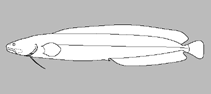
Raios dorsais (total) : 69 - 78; Raios anais : 60 - 67; Vértebras: 74 - 81. This species is distinguished by the following characters: body long, robust and slightly compressed; D 69-78, A 60-67, caudal-fin rays 8-10 and pectoral-fin rays 21-25; vertebrae precaudal 34-37, total 74-81; origin of dorsal fin above vertebra 27-30, anterior gill arch with 27-32 long rakers; fangs on vomer 3-5 and on each dentary 3-5; predorsal length 47.0-52 % SL; otolith small (3 mm long in 20.0 cm SL holotype). Colouration: pigment laterally on body absent, dark blue peritoneum and newly caught specimen reddish all over (Ref. 128809).
Cross section: compressed.
Maximum length of ripe female 20.0 cm SL caught by demersal trawl and unripe male, 8.5 cm SL collected at 1191-1262 m by an otter trawl (Ref. 128809).
Ciclo de vida ou comportamento de acasalamento
Maturidade | Reprodução | Desova | Ovos | Fecundidade | Larvas
Nielsen, J.G., 2019. Revision of the circumglobal genus Barathronus (Ophidiiformes, Bythitidae) with a new species from the eastern North Atlantic Ocean. Zootaxa 4679(2):231-256. (Ref. 121928)
Status na Lista Vermelha da UICN (Ref. 130435: Version 2025-2 (Global))
Ameaça para os humanos
Harmless
Uso pelos humanos
Pescarias: sem interesse
Ferramentas
Relatórios especiais
Baixar XML
Fontes da internet
Estimativas baseadas em modelos
Índice de diversidade filogenética (Ref.
82804): PD
50 = 0.5005 [Uniqueness, from 0.5 = low to 2.0 = high].
Bayesian length-weight: a=0.00479 (0.00192 - 0.01191), b=3.03 (2.81 - 3.25), in cm total length, based on LWR estimates for this (Sub)family-body shape (Ref.
93245).
Nível Trófico (Ref.
69278): 3.5 ±0.5 se; based on size and trophs of closest relatives
Resiliência (Ref.
120179): médio(a), tempo mínimo de duplicação da população 1,4 - 4,4 anos (Preliminary K or Fecundity.).
Vulnerabilidade da pesca (Ref.
59153): Low vulnerability (14 of 100).
🛈