Classificação / Nomes
Nomes comuns | Sinónimos | Catalog of Fishes(Género, Espécies) | ITIS | CoL | WoRMS | Cloffa
>
Cichliformes (Cichlids, convict blennies) >
Cichlidae (Cichlids) > Pseudocrenilabrinae
Etymology: Labeotropheus: Latin, labeo = one who has large lips + Greek, tropaion = defeat, a memorial of a fighting war, trophy; because of their specialized teeth were such an obvious feeding adaptation (Ref. 45335); obscurus: The specific epithet is the masculine form of the Latin adjective obscurus, meaning dark, dusky, or shadowy, in reference to the muted and mostly grey male nuptial colour pattern, which is unusual for a species of Labeotropheus (Ref. 128773).
Ambiente: milieu / zona climática / intervalo de profundidade / gama de distribuição
Ecologia
; Água doce bentopelágico. Tropical
Africa: Malawi.
Tamanho / Peso / Idade
Maturidade: Lm ? range ? - ? cm
Max length : 7.8 cm SL macho/indeterminado; (Ref. 128773)
Descrição breve
Chaves de identificação | Morfologia | Morfometria
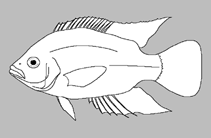
Espinhos dorsais (total) : 16 - 18; Raios dorsais moles (total) : 7 - 9; Espinhos anais: 3; Raios anais moles: 7 - 8. Diagnosis: Labeotropheus obscurus differs from all other species of Labeotropheus due to the unusually drab and muted colouration of sexually mature males; male nuptial colour pattern dominated by grey and brown pigmentation, with some blue and orange highlights on scales and fins, as opposed to a nuptial colour pattern dominated by blue, orange, or red pigmentation (Ref. 128773). Labeotropheus obscurus differs from the slender-bodied Labeotropheus species, L. trewavasae, L. simoneae, and L. chirangali, but not L. rubidorsalis, due to its greater body depth, 35.2-41.5% of standard length vs. 26.3-33.4% in L. trewavasae, 26.9-30.8% in L. simoneae and 26.6-33.2% in L. chirangali; it typically has a greater body depth than L. rubidorsalis, although the ranges slightly overlap, 31.6-36.1% of standard length in L. rubidorsalis; overall, L. obscurus does have a deeper body than L. rubidorsalis as indicated by several other measurements akin to body depth, including the distance between the origin of the dorsal fin and the origin of the anal fin, 50.8-56.3% of standard length vs. 45.6-50.3%, the distance between the insertion of the dorsal fin and the insertion of the anal fin, 15.8-17.8% of standard length vs. 13.5-15.7%, the distance between the insertion of the dorsal fin and the origin of the anal fin, 30.3-33.2% of standard length vs. 27.6-30.3%, and the distance between the origin of the dorsal fin and the attachment of the pelvic fins, 35.4-40.5% of standard length vs. 31.5-35.4% (Ref. 128773). Labeotropheus obscurus has a distinctly larger eye diameter than several of the robust species of L.abeotropheus, 27.3-32.4% of head length vs. 23.7-26.6% in L. fuelleborni, 22.6-25.5% in L. chlorosiglos, and 24.9-27.5% in L. alticodia; it also has fewer rows of teeth in the upper jaw than all robust Labeotropheus except L. alticodia, 3-4 vs. 4-5 in L. fuelleborni, 5-7 in L. chlorosiglos, 5-8 in L. artatorostris, 4-6 in L. aurantinfra, and 4-6 in L. candipygia, and fewer teeth in the left side of the lower jaw, 20-26 vs. 31-43 in L. fuelleborni, 30-37 in L. chlorosiglos and 29-35 in L. alticodia (Ref. 128773).
Ciclo de vida e comportamento de acasalamento
Maturidade | Reprodução | Desova | Ovos | Fecundidade | Larvas
Pauers, M.J. and T.B. Phiri, 2023. Six new species of Labeotropheus (Cichliformes: Cichlidae) from the Malawian shore of Lake Malawi, Africa. Ichthyology & Herpetology 111(2):264-292. (Ref. 128773)
Categoria na Lista Vermelha da IUCN (Ref. 130435: Version 2025-2 (Global))
Ameaça para o homem
Harmless
Utilização humana
Pescarias: sem interesse
Ferramentas
Relatórios especiais
Descarregue XML
Fontes da internet
Estimativas baseadas em modelos
Índice de diversidade filogenética (Ref.
82804): PD
50 = 0.5005 [Uniqueness, from 0.5 = low to 2.0 = high].
Bayesian length-weight: a=0.01445 (0.00671 - 0.03113), b=2.99 (2.82 - 3.16), in cm total length, based on LWR estimates for this (Sub)family-body shape (Ref.
93245).
Nível Trófico (Ref.
69278): 3.3 ±0.4 se; based on size and trophs of closest relatives
Resiliência (Ref.
120179): Elevada, tempo mínimo de duplicação da população menor que 15 meses (Preliminary K or Fecundity.).
Vulnerabilidade da pesca (Ref.
59153): Low vulnerability (10 of 100).
🛈