klasifikasi / Nama
Nama-nama umum | Sinonim (persamaan) | Catalog of Fishes(Marga, Jenis) | ITIS | CoL | WoRMS | Cloffa
>
Cichliformes (Cichlids, convict blennies) >
Cichlidae (Cichlids) > Pseudocrenilabrinae
Etymology: Labeotropheus: Latin, labeo = one who has large lips + Greek, tropaion = defeat, a memorial of a fighting war, trophy; because of their specialized teeth were such an obvious feeding adaptation (Ref. 45335); chirangali: Chirangali is the Chichewa word for beacon, referring to the navigational beacon present on Mphanga Rocks (Ref. 128773).
Lingkungan: lingkungan / zona iklim / kisaran kedalaman / jangkauan distribusi
Ekologi
; air tawar bentopelagis. Tropical
Africa: Malawi,
Ukuran / Berat / umur
Kematangan: Lm ? range ? - ? cm
Max length : 11.2 cm SL jantan/; (Ref. 128773)
deskripsi pendek
Kunci identifiaksi (pengenalan) | Morfologi | Morfometrik
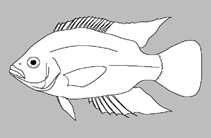
Duri punggung (Keseluruhan (total)) : 18 - 19; duri punggung lunak (Keseluruhan (total)) : 8 - 9; Duri dubur: 3; Sirip dubur lunak: 7 - 9. Diagnosis: Labeotropheus chirangali differs from the robust Labeotropheus, except L. chlorosiglos and L. candipygia, due to its slender body, 26.6-33.2% of standard length vs. 35.2-41.6% in L. fuelleborni, 33.8-41.5% in L. aurantinfra, 35.2-41.5% in L. obscurus, 37.4-40.6% in L. alticodia and 34.3-42.0% in L. artatorostris; it has a slenderer body than L. chlorosiglos and L. candipygia, although its range of body depth partially overlaps with those of these species, 31.9-34.7% in L. chlorosiglos and 31.9-38.6% in L. candipygia (Ref. 128773). There are additional morphometric differences between L. chirangali and both L. chlorosiglos and L. candipygia, although some of the ranges overlap; it differs from both L. chlorosiglos and L. candipygia by shorter distances between the tip of the snout and the origin of the dorsal fin, 28.4-32.7% of standard length vs. 31.2-34.4% in L. chlorosiglos and 32.2-36.8% in L. candipygia, between the origin of the dorsal fin and the origin of the anal fin, 32.2-51.5% of standard length vs. 51.3-54.6% in L. chlorosiglos and 47.6-54.0% in L. candipygia, and between the origin of the dorsal fin and the attachment of the pelvic fins, 28.6-33.4% of standard length vs. 33.0-36.0% in L. chlorosiglos and 32.7-38.8% in L. candipygia; additionally, L. chirangali has a greater width between the opercular tabs, 15.1-17.8% of head length vs. 14.7-15.7% in L. chlorosiglos (Ref. 128773). Labeotropheus chirangali differs from the other slender-bodied Labeotropheus primarily due to the nuptial colouration of the males; male L. chirangali have a dark blue head, flank, and ventrum, and the scales in this region may have small ochreous-orange highlights; above this extensive dark blue patch, male L. chirangali have a bright sky-blue dorsum; this pigmentation extends onto the dorsal fin; the tips of the dorsal fin are yellow, as is the trailing edge of this fin; the anal fin and the pelvic fins are the same bright sky blue as the dorsal fin (Ref. 128773). Many of the morphometric and meristic values of L. chirangali overlap with those of the other slender Labeotropheus, although there are some distinctions; it differs from L. trewavasae due to a larger snout pad, 13.6-19.4% of head length vs. 10.3-14.2%, a wider lower jaw, 39.0-49.5% of head length vs. 34.7-43.9%, fewer rows of teeth in the lower jaw, 3-5 vs. 5-6, and more infraorbital neuromasts, 14-38 vs. 8-25; it differs from L. simoneae due to a greater rostral length, 39.2-47.6% of head length vs. 34.3-43.0%, a larger snout pad, 13.6-19.4% of head length vs. 9.5-15.9%, and fewer overlapping lateral line scales, 0-3 vs. 4-5; finally, L. chirangali differs from L. rubidorsalis due to a smaller distance between the tip of the snout and the origin of the dorsal fin, 28.4-32.7% of standard length vs. 31.4-35.0%, a greater distance between the insertion of the dorsal fin and the attachment of the pelvic fins, 54.1-58.8% of standard length vs. 49.5-55.1%, a smaller preorbital depth, 23.4-28.4% of head length vs. 26.6-32.9%, a larger snout pad, 13.6-19.4% of head length vs. 10.3-14.2%, and a greater number of ceratobranchial gill rakers, 7-10 vs. 5-8 (Ref. 128773).
Siklus hidup dan perilaku kawin
Kematangan | Reproduksi, perkembang biakan | Pemijahan | telur-telur | Fekunditas | Larva
Pauers, M.J. and T.B. Phiri, 2023. Six new species of Labeotropheus (Cichliformes: Cichlidae) from the Malawian shore of Lake Malawi, Africa. Ichthyology & Herpetology 111(2):264-292. (Ref. 128773)
Status IUCN Red List (Ref. 130435: Version 2025-2 (Global))
ancaman kepada manusia
Harmless
penggunaan manusia
Perikanan: tidak ada kepentingan
Alat, peralatan
laporan khas
muat turun XML
Sumber internet
Estimasi berdasarkan model
Indeks keanekaragaman filogenetik (Acuan
82804): PD
50 = 0.5005 [Uniqueness, from 0.5 = low to 2.0 = high].
Bayesian length-weight: a=0.01445 (0.00671 - 0.03113), b=2.99 (2.82 - 3.16), in cm total length, based on LWR estimates for this (Sub)family-body shape (Ref.
93245).
Tingkat Trofik (Acuan
69278): 3.4 ±0.4 se; based on size and trophs of closest relatives
Daya lenting (Acuan
120179): Tinggi, Waktu penggandaan populasi minimum kurang dari 15 bulan (Preliminary K or Fecundity.).
Kerentanan Penangkapan Ikan (Ref.
59153): Low vulnerability (10 of 100).
🛈