Classificazione / Nomi
Nomi Comuni | Sinonimi | Catalog of Fishes(Genere, Specie) | ITIS | CoL | WoRMS | Cloffa
>
Siluriformes (Catfishes) >
Sisoridae (Sisorid catfishes) > Sisorinae
Etymology: Glyptothorax: Greek, glyptes = carver + Greek, thorax = breast (Ref. 45335); decussatus: Name from Latin verb 'decusso', meaning to divide crosswise in the form of an X, referring to the dark vertical mark at the base of the caudal fin, which is shaped like an irregular cross.
Ambiente: milieu / zona climatica / distribuzione batimetrica / gamma di distribuzione
Ecologia
; acqua dolce benthopelagico. Tropical
Asia: Indonesia.
Dimensione / Peso / Età
Maturità: Lm ? range ? - ? cm
Max length : 7.8 cm SL maschio/sesso non determinato; (Ref. 128699)
Breve descrizione
Chiavi di identificazione | Morfologia | Morfometria
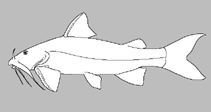
This species is distinguished from its congeners in Sundaland except for G. amnestus, G. major, G. plectilis<.i> in having (vs. lacking) anteromedial striae on the thoracic adhesive apparatus; differs from G. amnestus in having (vs. lacking) a dark vertical bar at the base of the caudal fin in the shape of an irregular cross; differs from G. major in having a deeper caudal peduncle, 10.3-10.9% SL (vs. 7.7-10.1) and with a faint, pale band around the caudal peduncle (vs. absent); differs from G. plectilis in having non-prominent tubercles of uniform size (vs. with prominent, enlarged tubercles) along the flanks. It is further distinguished from Sundaic congeners by the following unique characters: premaxillary tooth band approximately half exposed when mouth is closed; eye diameter 8-9% HL; head length 27.2-30.2% SL and width 19.9-22.3% SL; predorsal length 35.8-40.0% SL; dorsal-fin spine length 16.0-17.3% SL; margin of dorsal fin concave; dorsal-to-adipose distance 18.6-21.2% SL; body depth at anus 17.8-19.7% SL; straight dorsoposterior margin of the adipose fin; post-adipose distance 16.2-17.5% SL; caudal peduncle depth is 2.0 times in body depth at dorsal-fin origin; no dark vertical bars at adipose-fin base and caudal-fin base and prominent pale midlateral stripe on the body (Ref. 128699).
Cross section: oval.
Ciclo vitale e comportamento di accoppiamento
Maturità | Riproduzione | Deposizione | Uova | Fecondità | Larve
Ng, H.H. and M. Kottelat, 2016. The Glyptothorax of Sundaland: a revisionary study (Teleostei: Sisoridae). Zootaxa 4188(1):001-092. (Ref. 128699)
Stato della Lista Rossa IUCN (Ref. 130435: Version 2025-2 (Global))
Minaccia per l'uomo
Harmless
Usi umani
Pesca: di nessun interesse
Strumenti
Rapporti speciali
Scarica XML
Fonti Internet
Stime basate su modelli
Indice di diversità filogenetica (Fonte Biblio.
82804): PD
50 = 0.5000 [Uniqueness, from 0.5 = low to 2.0 = high].
Bayesian length-weight: a=0.00794 (0.00365 - 0.01726), b=3.02 (2.85 - 3.19), in cm total length, based on LWR estimates for this Genus-body shape (Ref.
93245).
Livello trofico (Fonte Biblio.
69278): 3.2 ±0.4 se; based on size and trophs of closest relatives
Resilienza (Fonte Biblio.
120179): Medio, tempo minimo di raddoppiamento della popolazione 1.4 - 4.4 anni (Preliminary K or Fecundity.).
Vulnerabilità della pesca (Ref.
59153): Low vulnerability (10 of 100).
🛈