การจำแนกประเภท / ชื่อ
ชื่อสามัญ | ชื่อพ้อง | Catalog of Fishes(สกุล, ชนิด) | ITIS | CoL | WoRMS | Cloffa
>
Gobiiformes (Gobies) >
Gobiidae (Gobies) > Gobiinae
Etymology: Psilotris: Greek, psilos = hairless + Greek, thrix = hair (Ref. 45335); laetarii: Named for Heath Jens Laetari (Ref. 113825).
Eponymy: Heath Jens Laetari (1978–2006) was Vice President of Dive Operations, Partner & Acquisition Manager for Dynasty Marine (a supplier of live Caribbean marine life), who was lost at sea during a free dive in the Florida Keys. [...] (Ref. 128868), visit book page.
สิ่งแวดล้อม : สิ่งแวดล้อม / เขตภูมิอากาศ / ระดับความลึก / ระยะการกระจายสินค้า
นิเวศวิทยา
เกี่ยวกับทะเล,น้ำเค็ม สัตว์น้ำหน้าดิน; ระดับความลึก 8 - ? m (Ref. 113825). Tropical
Western Central Atlantic: Florida, USA.
ขนาด / น้ำหนัก / อายุ
วัยเจริญพันธุ์: Lm ? range ? - ? cm
Max length : 2.3 cm SL เพศผู้/กระเทย; (Ref. 113825); 2.4 cm SL (female)
คำอธิบายสั้นๆ
เครื่องมือที่ใช้ในการแยกชนิดสัตว์,สิ่งมีชีวิตออกจากกัน | สัณฐานวิทยา | ความยาวต่างๆ
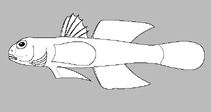
เงี่ยงครีบหลัง (รวม) : 8; ก้านครีบอ่อนที่หาง (รวม) : 9 - 10; ก้านครีบอ่อนที่ก้น: 7 - 8. This species can be distinguished by the following set of characters: D1 VII, without elongate spines; D2 I, 9-10; A I, 7-8; pelvic fins well separated, no anterior frenum, membrane connecting 5th pelvic-fin rays absent or very low; 5th pelvic ray unbranched and 1/2 length of fourth; no without fleshy tips in pelvic-fin; side of body and head without scales; no modified basicaudal scales present; papillae row 5s and 5i connected forming a single row, interorbital papillae row pc’ present; head and preopercle canals and pores absent; two anal-fin pterygiophores inserted anterior to haemal arch. Colouration: reticulating yellowish orange pattern on the body (Ref. 113825).
Cross section: oval.
Found in back-reef rubble habitat. Collected from a sand and rubble (ca. 0.5-10.0 cm in diameter) substrate, 45-90 m from the gradual reef drop-off. Found in or near yellowhead jawfish (Opistognathus aurifrons) burrows. Although not a common species, this species is regularly seen from April to November, which is when jawfish are abundant (Ref. 113825).
วงจรชีวิตและพฤติกรรมการผสมพันธุ์
วัยเจริญพันธุ์ | การสืบพันธุ์ | การวางไข่ | เซลสืบพันธ์ของเพศเมีย(ไข่) | ความดกของไข่ | ตัวอ่อน
Tornabene, L., J.L. Van Tassel, D.R. Robertson and C.C. Baldwin, 2016. Molecular phylogeny, analysis of discrete character evolution, and submersible collections facilitate a new classification for a diverse group of gobies (Teleostei: Gobiidae: Gobiosomatini: Nes subgroup), with descriptions of nine new species. Zoological Journal of the Linnean Society 177(4):764-812. (Ref. 113825)
สถานะบัญชีแดงของ IUCN (Ref. 130435: Version 2025-2 (Global))
ภัยคุกคามต่อมนุษย์
Harmless
การใช้ของมนุษย์
เครื่องมือ
รายงานพิเศษ
ดาวน์โหลด XML
แหล่งที่มาจากอินเตอร์เน็ต
การประมาณค่าตามแบบจำลอง
ดัชนีความหลากหลายทางวิวัฒนาการ (อ้างอิง
82804): PD
50 = 0.5156 [Uniqueness, from 0.5 = low to 2.0 = high].
Bayesian length-weight: a=0.00741 (0.00347 - 0.01582), b=3.09 (2.91 - 3.27), in cm total length, based on LWR estimates for this (Sub)family-body shape (Ref.
93245).
ระดับชั้นอาหาร (อ้างอิง
69278): 3.1 ±0.3 se; based on size and trophs of closest relatives
ความสามารถในการกลับคืนสู่ปกติ (อ้างอิง
120179): ความสูง, เวลาต่ำสุดที่จะทำให้ประชากรเพิ่มขึ้นเป็น 2 เท่าใช้เวลาน้อยกว่า 15 เดือน (Preliminary K or Fecundity.).
ความเสี่ยงต่อการตกปลา (Ref.
59153): Low vulnerability (10 of 100).
🛈