Classification / Noms
Noms communs | Synonymes | Catalog of Fishes(Genre, Espèce) | ITIS | CoL | WoRMS | Cloffa
>
Atheriniformes (Silversides) >
Melanotaeniidae (Rainbowfishes, blue eyes)
Etymology: Melanotaenia: Greek, melan, -anos = black + latin, taenia = stripe (Ref. 45335); wilsoni: Named for David Wilson, who was the first person to document the presence of the small isolated population in the Northern Territory.
Eponymy: David Wilson works at Territory Wildlife Park, Berry Springs (Northern Territory, Australia). [...] (Ref. 128868), visit book page.
Environnement : milieu / zone climatique / profondeur / gamme de distribution
Écologie
; eau douce benthopélagique; pH range: 6.0 - 6.5; dH range: ? - 10; profondeur 0 - 1 m (Ref. 121823). Tropical; 23°C - 24°C (Ref. 121823)
Oceania: Australia.
Taille / Poids / Âge
Maturité: Lm ? range ? - ? cm
Max length : 3.3 cm SL mâle / non sexé; (Ref. 121823)
Description synthétique
Clés d'identification | Morphologie | Morphométrie
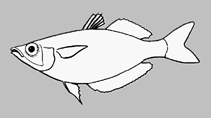
Épines dorsales (Total) : 5 - 7; Rayons mous dorsaux (Total) : 7 - 9; Épines anales: 1; Rayons mous anaux: 13 - 16; Vertèbres: 31 - 33. This species with well-contrasted dark lateral body stripes, is distinguished by the following set of characters: D IV-VI, I,7-9 (mode 8); A I,13-16 (mode 14); total procurrent caudal rays 11-13 (mode 12); lateral scales 30-32 (mode 31); cheek scales usually 8-9; total gill rakers on first arch 14-16; vertebrae 31-33 (mode 32); body deep with greatest depth 3.1-3.6 (mean 3.3) in SL and greatest width 1.9-2.9 (mean 2.3) in HL; maxilla is relatively short 4.0-4.7 (mean 4.3) in HL; long predorsal distance 1.9-2.1 (mean 2.1) in SL. Colouration: when alive, brown to whitish body with a series of black lateral stripes the middle being the most distinct in having a dark purple hue; fins pale with diffuse patterns and most pronounced in nuptial males (Ref. 121823).
Cross section: compressed.
Habitat is shallow (<50 cm) comprising small Pandanus lined spring fed creeks over sandy soils with strong lateral connectivity to densely vegetated peat swamp and side-channel areas. Swamp and channel habitats can be seasonal or retract to refuge holes. Water transparency ranges from clear (streams) to heavily stained, indicative of water quality parameters in the dry season including pH 6.0–6.5 (noted also as 5.0: Armstrong 1995), temperature 23–24°C, water conductivity 15–30 ìScm-1 and general hardness and carbonate hardness <10 ppm. Occurs with regionally ubiquitous Melanotaenia nigrans and Mogurnda mogurnda and other swamp dwelling fish including Pseudomugil gertrudae, Oxyeleotris nullipora, Porochilus obbesi, Denariusa bandata, and Ophisternon gutturale. Little else is known on the biology of this species other than records of spawning and behaviour in captivity, where it is observed as extremely shy, which is viewed as an adaption to shallow habitat (Ref. 121823).
Cycle de vie et comportement reproducteur
Maturité | Reproduction | Frai | Œufs | Fécondité | Larves
Hammer, M.P., G.R. Allen, K.C. Martin, M. Adams and P.J. Unmack, 2019. Two new species of dwarf rainbowfishes (Atheriniformes: Melanotaeniidae) from northern Australia and southern New Guinea. Zootaxa 4701(3):201-234. (Ref. 121823)
Statut dans la liste rouge de l'IUCN (Ref. 130435: Version 2025-2 (Global))
Menace pour l'homme
Harmless
Utilisations par l'homme
Pêcheries: commercial; Aquarium: Commercial
Outils
Articles particuliers
Télécharger en XML
Sources Internet
Estimations basées sur des modèles
Indice de diversité phylogénétique (Réf.
82804): PD
50 = 0.5000 [Uniqueness, from 0.5 = low to 2.0 = high].
Bayesian length-weight: a=0.01122 (0.00514 - 0.02450), b=3.04 (2.87 - 3.21), in cm total length, based on all LWR estimates for this body shape (Ref.
93245).
Niveau trophique (Réf.
69278): 3.0 ±0.4 se; based on size and trophs of closest relatives
Résilience (Réf.
120179): Haut, temps minimum de doublement de population inférieur à 15 mois (Preliminary K or Fecundity.).
Vulnérabilité de la pêche (Ref.
59153): Low vulnerability (10 of 100).
🛈