Ambiente: milieu / zona climática / intervalo de profundidade / gama de distribuição
Ecologia
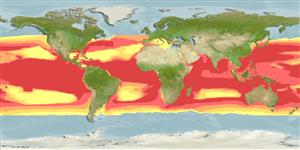
marinhas pelagic-oceanic; oceanódromo (Ref. 87829); intervalo de profundidade 0 - 400 m (Ref. 86942). Subtropical; 24°C - ? (Ref. 26); 48°N - 48°S, 180°W - 180°E (Ref. 55203)
Worldwide in tropical and subtropical seas. Frequently misidentified as juvenile or female of Coryphaena hippurus. Highly migratory species.
Comprimento na primeira maturidade / Tamanho / Peso / Idade
Maturidade: Lm ?, range 22 - ? cm
Max length : 146 cm TL macho/indeterminado; (Ref. 111105); common length : 50.0 cm TL macho/indeterminado; (Ref. 2683); Idade máx. registada: 4 anos (Ref. 26)
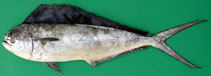
Espinhos dorsais (total) : 0; Raios dorsais moles (total) : 52 - 59; Espinhos anais: 0; Raios anais moles: 24 - 28; Vértebras: 33. Body elongated and compressed, its depth contained less than 4.0 times in standard length (adults); tongue with a wide tooth patch covering 50 to 60 percent of its surface; dorsal fin originating on nape, almost reaching caudal fin, with 48 to 55 rays; anterior distal edge of anal fin convex; pectoral fins located near middle of head; body shiny blue green, changing to gray with green tints after death; flanks with golden highlights and numerous diffuse black stains (Ref. 55763). Greatest body depth more than 25% of SL; tooth patch on tongue broad and square; single dorsal fin extending from just behind eye almost to caudal fin, with 52-59 rays; a convex anal fin extending from anus almost to caudal fin; pectoral fin about half of head length (Ref. 10948). Caudal vertebrae usually 20. (Ref. 10998). Color in life brilliant metallic blue-green dorsally, fading to grey with green tinge upon death; sides silvery with golden sheen and spots; dorsal fin dark; juveniles with entire caudal fin margin white. Head profile of large adults (30-200 cm.) becomes vertical with the development of bony crest, but more in males.
Body shape (shape guide): fusiform / normal; Cross section: compressed.
Primarily an oceanic species but may enter coastal waters (Ref. 9293). Usually forms schools. Follows boats and may be found under floating objects (Ref. 9293). Feeds on small fishes and squid (Ref. 9293). Eggs and larvae are pelagic (Ref. 6755). Marketed fresh and considered an excellent food fish (Ref. 5288). An important game fish in northern South America (Ref. 5217).
Palko, B.J., G.L. Beardsley and W.J. Richards, 1982. Synopsis of the biological data on dolphin-fishes, Coryphaena hippurus Linnaeus and Coryphaena equiselis Linnaeus. FAO Fish. Synop. (130); NOAA Tech. Rep. NMFS Circ. (443). (Ref. 26)
Categoria na Lista Vermelha da IUCN (Ref. 130435: Version 2025-2 (Global))
Ameaça para o homem
Harmless
Utilização humana
Pescarias: pouco comercial; peixe desportivo: sim
Ferramentas
Relatórios especiais
Descarregue XML
Fontes da internet
Estimativas baseadas em modelos
Temperatura preferida (Ref.
123201): 14.2 - 27.9, mean 22.3 °C (based on 1841 cells).
Índice de diversidade filogenética (Ref.
82804): PD
50 = 1.0000 [Uniqueness, from 0.5 = low to 2.0 = high].
Bayesian length-weight: a=0.01230 (0.00481 - 0.03145), b=2.98 (2.76 - 3.20), in cm total length, based on LWR estimates for this (Sub)family-body shape (Ref.
93245).
Nível Trófico (Ref.
69278): 4.5 ±0.60 se; based on food items.
Resiliência (Ref.
120179): Médio, tempo mínimo de duplicação da população 1,4 - 4,4 anos (tmax=4; Fec>10,000).
Vulnerabilidade da pesca (Ref.
59153): Very high vulnerability (87 of 100).
🛈
Nutrientes (Ref.
124155): Calcium = 52.4 [27.6, 113.8] mg/100g; Iron = 1.61 [0.83, 3.03] mg/100g; Protein = 20.2 [18.9, 21.4] %; Omega3 = 0.438 [0.234, 0.836] g/100g; Selenium = 52.1 [24.7, 112.6] μg/100g; VitaminA = 4.46 [1.28, 16.52] μg/100g; Zinc = 0.436 [0.285, 0.699] mg/100g (wet weight);