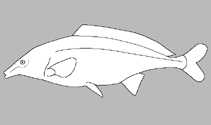
>
Osteoglossiformes (Bony tongues) >
Mormyridae (Elephantfishes)
Etymology: Marcusenius: Becasue of J. Marcusen, author of "Zur Phauna des Schwarzen Meeres", 1867; ichthyologist; lambouri: This species is dedicated to Mr. Lambour, from the Herpetology Laboratory of the Natural History Museum of Paris (Ref. 42494, 124516).
Eponymy: Dr Johann Andreas Marcusen (1817–1894) was a Latvian of German descent who was a physician, ichthyologist and zoologist. [...] Jean-Baptiste Lambour was a ‘préparateur’ in the herpetological department of the Muséum National d’Histoire Naturelle (1891–1924) and Pellegrin’s colleague. (Ref. 128868), visit book page.
Ambiente: milieu / zona climática / intervalo de profundidade / gama de distribuição
Ecologia
; Água doce bentopelágico; pH range: 4.2 - 6.5. Tropical; 23°C - 25°C (Ref. 124516)
Africa: Middle Congo basin.
Tamanho / Peso / Idade
Maturidade: Lm ? range ? - ? cm
Max length : 13.7 cm SL macho/indeterminado; (Ref. 124516)
Descrição breve
Chaves de identificação | Morfologia | Morfometria
Espinhos dorsais (total) : 0; Raios dorsais moles (total) : 19 - 23; Espinhos anais: 0; Raios anais moles: 23 - 28; Vértebras: 44 - 45. Diagnosis: Marcusenius lambouri belongs to the group of species of Marcusenius with eight large circumpeduncular scales (Ref. 124516). Within this group, it can be distinguished from M. dundoensis, M. fuscus and M. sanagaensis by its low number of lateral line scales, 44-46 vs. 51-61, 54-61 and 49-56, respectively; and from M. intermedius, M. moorii and M. verheyenorum by its high number of lateral line scales, 44-46 vs. 38-43, 40-43 and 38-43, respectively (Ref. 124516). It differs from M. ghesquierei and M. kutuensis by its low number of dorsal-fin rays, 19-23 vs. 32-34 and 27-31, respectively; and from M. schilthuisiae and M. wamuinii by its lower number of anal-fin rays, 23-28 vs. 32-34 and 30-32, respectively (Ref. 124516). Finally, it differs from M. kaninginii by a high total number of vertebrae, 44-45 vs. 43-44, shallow caudal-peduncle depth, 29.6-38.2% of its length vs. 38.4-45.1%, the absence of a longitudinal black band along the flanks vs. band present, and a medial black line on each of the flank scales vs. absence of such a line on the flank scales (Ref. 124516).
Ciclo de vida e comportamento de acasalamento
Maturidade | Reprodução | Desova | Ovos | Fecundidade | Larvas
Mambo Baba, T., T. Kisekelwa, C. Danadu Mizani, E. Decru and E. Vreven, 2020. Hidden species diversity in Marcusenius moorii (Teleostei: Mormyridae) from the Congo Basin. J. Fish Biol. 96(5):1100-1122. (Ref. 124516)
Categoria na Lista Vermelha da IUCN (Ref. 130435: Version 2025-2 (Global))
Ameaça para o homem
Harmless
Utilização humana
Ferramentas
Relatórios especiais
Descarregue XML
Fontes da internet
Estimativas baseadas em modelos
Índice de diversidade filogenética (Ref.
82804): PD
50 = 0.5000 [Uniqueness, from 0.5 = low to 2.0 = high].
Bayesian length-weight: a=0.01288 (0.00585 - 0.02838), b=2.88 (2.70 - 3.06), in cm total length, based on LWR estimates for this Genus-body shape (Ref.
93245).
Nível Trófico (Ref.
69278): 3.1 ±0.4 se; based on size and trophs of closest relatives
Resiliência (Ref.
120179): Elevada, tempo mínimo de duplicação da população menor que 15 meses (Preliminary K or Fecundity.).
Vulnerabilidade da pesca (Ref.
59153): Low vulnerability (10 of 100).
🛈