>
Perciformes/Scorpaenoidei (Scorpionfishes) >
Synanceiidae (Stonefishes) > Minoinae
Etymology: roseus: Named for Mr Rokus Groeneveld, who provided the excellent underwater photographs of this new species.
Environnement : milieu / zone climatique / profondeur / gamme de distribution
Écologie
marin démersal; profondeur 76 - 165 m (Ref. 128010). Tropical
Indo-West Pacific: northwestern Australia, Indonesia (north Sulawesi) and the Maldives.
Taille / Poids / Âge
Maturité: Lm ? range ? - ? cm
Max length : 7.2 cm SL mâle / non sexé; (Ref. 128010)
Description synthétique
Clés d'identification | Morphologie | Morphométrie
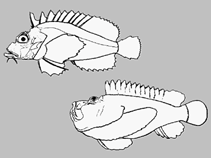
Épines dorsales (Total) : 10 - 11; Rayons mous dorsaux (Total) : 10 - 12; Épines anales: 2; Rayons mous anaux: 8 - 10; Vertèbres: 26. This species is distinguished from its congeners by the following characters: D X-XI,10-12 (modally XI,11), total rays 21-22 (22) with the first dorsal-fin spine much shorter than the second, with bases close together; A II,8-10 (II,9), total rays 10-12 (11); head depth 18.8-21.6% (mean 20.0%) of SL; eye set high on the head (horizontal line through top of snout bulge well below the ventral margin of pupil in specimens >60 mm SL); anterior and posterior lacrimal spines are sharp, the anterior spine tip canted anteroventrally while posterior spine tip canted anteroventrally or ventrally in specimens >60 mm SL; skin flap associated with pore above pectoral-fin base long and tentacle-like. Colouration: body entirely pale pink or yellow with narrow dark stripe centrally, no oblique alternating dark and light stripes; pectoral fin inner surface is largely bright yellow (whitish in preserved specimens), basally with dark stripes along rays, distal part largely yellow (whitish) when fresh (Ref. 128010).
Cross section: oval.
Cycle de vie et comportement reproducteur
Maturité | Reproduction | Frai | Œufs | Fécondité | Larves
Matsunuma, M. and H. Motomura, 2018. Three new species of the Indo-Pacific stingfish genus Minous (Synanceiidae: Minoinae) with redescriptions of M. trachycephalus (Bleeker 1855) and M. pictus Günther 1880. Zootaxa 4455(2):201-257. (Ref. 128010)
Statut dans la liste rouge de l'IUCN (Ref. 130435: Version 2025-2 (Global))
Menace pour l'homme
Harmless
Utilisations par l'homme
Pêcheries: bycatch
Outils
Articles particuliers
Télécharger en XML
Sources Internet
Estimations basées sur des modèles
Indice de diversité phylogénétique (Réf.
82804): PD
50 = 0.5000 [Uniqueness, from 0.5 = low to 2.0 = high].
Bayesian length-weight: a=0.01072 (0.00421 - 0.02727), b=3.03 (2.81 - 3.25), in cm total length, based on LWR estimates for this (Sub)family-body shape (Ref.
93245).
Niveau trophique (Réf.
69278): 3.6 ±0.7 se; based on size and trophs of closest relatives
Résilience (Réf.
120179): Haut, temps minimum de doublement de population inférieur à 15 mois (Preliminary K or Fecundity.).
Vulnérabilité de la pêche (Ref.
59153): Low vulnerability (10 of 100).
🛈