Klassifizierung / Names
Namen | Synonyme | Catalog of Fishes(Gattung, Arten) | ITIS | CoL | WoRMS | Cloffa
>
Cyprinodontiformes (Rivulines, killifishes and live bearers) >
Rivulidae (Rivulines) > Cynolebiinae
Etymology: splendissimus: Name from Latin 'splendissimus', i.e., very splendid, alluding to the vivid coloration in males, one of the most colorful aplocheiloid killifishes in South America (Ref. 119423).
Umwelt: Milieu / Klimazone / Tiefenbereich / Verbreitungsgebiet
Ökologie
; süßwasser benthopelagisch. Tropical
South America: Brazil.
Größe / Gewicht / Alter
Geschlechtsreife: Lm ? range ? - ? cm
Max length : 4.3 cm SL Männchen/unbestimmt; (Ref. 119423); 3.1 cm SL (female)
Kurzbeschreibung
Bestimmungsschlüssel | Morphologie | Morphometrie
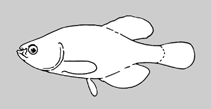
This species is distinguished from its congeners H. fulminantis and H. shibattai by the following characters: in males, pectoral fin red (vs. hyaline), the filamentous rays well-developed on the tips of the dorsal and anal fins in adults (vs. absent or rudimentary, poorly visible), and the second proximal radial of the dorsal fin between the neural spines of the 8th and 9th vertebrae (vs. between neural spines of 6th and 7th vertebrae); differs from H. shibattai by having the dorsal-fin origin posterior to the anal-fin origin in males (vs. anterior), the distinctive red bars restricted to the anterior portion of the flank males (vs. extending over the whole flank), and absence of contact organs on the pectoral fin in males (vs. present) (Ref. 119423).
Cross section: oval.
Found in shallow temporary pool in flat plains, in shadier area densely occupied by aquatic vegetation. Maximum length based on type specimen, to be replaced with a better reference (Ref. 119423).
Lebenszyklus und Paarungsverhalten
Geschlechtsreife | Fortpflanzung | Ablaichen | Eier | Fruchtbarkeit | Larven
Costa, W.J.E.M., P.F. Amorim and J.L.O. Mattos, 2018. Diversity and conservation of seasonal killifishes of the Hypsolebias fulminantis complex from a Caatinga semiarid upland plateau, São Francisco River basin, northeastern Brazil (Cyprinodontiformes, Aplocheilidae). Zoosyst. Evol. 94(2):495-504. (Ref. 119423)
IUCN Rote Liste Status (Ref. 130435: Version 2025-2 (Global))
Bedrohung für Menschen
Harmless
Nutzung durch Menschen
Fischereien: nicht kommerziell
Tools
Zusatzinformationen
Download XML
Internet Quellen
Schätzungen auf der Grundlage von Modellen
Phylogenetischer Diversitätsindex (Ref.
82804): PD
50 = 0.5000 [Uniqueness, from 0.5 = low to 2.0 = high].
Bayesian length-weight: a=0.01122 (0.00514 - 0.02450), b=3.04 (2.87 - 3.21), in cm total length, based on all LWR estimates for this body shape (Ref.
93245).
Trophische Ebene (Ref.
69278): 3.2 ±0.4 se; based on size and trophs of closest relatives
Widerstandsfähigkeit (Ref.
120179): hoch, Verdopplung der Population dauert weniger als 15 Monate. (Preliminary K or Fecundity.).
Anfälligkeit der Fischerei (Ref.
59153): Low vulnerability (10 of 100).
🛈