Classification / Noms
Noms communs | Synonymes | Catalog of Fishes(Genre, Espèce) | ITIS | CoL | WoRMS | Cloffa
>
Cichliformes (Cichlids, convict blennies) >
Cichlidae (Cichlids) > Pseudocrenilabrinae
Etymology: Haplochromis: Greek, Haploos = single + Greek, chromis = a fish, perhaps a perch (Ref. 45335); relictidens: Specific name of Haplochromis relictidens derived from the Latin 'relinquere', to relinquish, and 'dens', tooth and used in apposition; it refers to the decrease in number of outer teeth in both jaws with size (Ref. 127594).
Environnement : milieu / zone climatique / profondeur / gamme de distribution
Écologie
; eau douce benthopélagique. Tropical
Africa: Lake Edward system (Ref. 127594).
Taille / Poids / Âge
Maturité: Lm ? range ? - ? cm
Max length : 11.3 cm SL mâle / non sexé; (Ref. 127594)
Description synthétique
Clés d'identification | Morphologie | Morphométrie
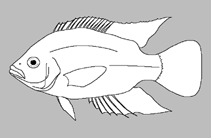
Épines dorsales (Total) : 15 - 16; Rayons mous dorsaux (Total) : 7 - 10; Épines anales: 3; Rayons mous anaux: 8 - 9; Vertèbres: 29. Diagnosis: Haplochromis relictidens differs from all other known species from the Lake Edward system by its unique lower jaw morphology in large specimens of more than 90 mm standard length, with lower jaw acute and upper jaw rounded, rendering anterolateral parts of upper jaw visible in ventral view; outer teeth very small, blunt to rounded, widely and irregularly set, few (16-26 vs. 22-65), and decreasing in number with size (Ref. 127594). It differs further from H. taurinus, H. molossus, and H. gracilifur by its more slender and acute lower jaw, 50.1-59.7% of lower jaw length vs. 51.4-72.7%, 67.0-87.0% and 61.9-69.4%, respectively; its larger lachrymal bones, 15.8-18.4% of head length vs. 11.5-16.4%, 13.3-17.0% and 13.7-14.3%, respectively (Ref. 127594). It is further distinct from H. paradoxus by its broader head, 47.7-54.7% of head length vs. 41.7-51.2% (Ref. 127594). Mature males green-gold with bright red flanks and very faint vertical stripes vs. different colour pattern in all other paedophagous species (Ref. 127594).
This species has a paedophagous diet (Ref. 127594).
Cycle de vie et comportement reproducteur
Maturité | Reproduction | Frai | Œufs | Fécondité | Larves
Vranken, N., M. Van Steenberge and J. Snoeks, 2019. Grasping ecological opportunities: not one but five paedophagous species of Haplochromis (Teleostei: Cichlidae) in the Lake Edward system. Hydrobiologia 832(1):105-134. (Ref. 127594)
Statut dans la liste rouge de l'IUCN (Ref. 130435: Version 2025-2 (Global))
Menace pour l'homme
Harmless
Utilisations par l'homme
Outils
Articles particuliers
Télécharger en XML
Sources Internet
Estimations basées sur des modèles
Indice de diversité phylogénétique (Réf.
82804): PD
50 = 0.5000 [Uniqueness, from 0.5 = low to 2.0 = high].
Bayesian length-weight: a=0.01445 (0.00671 - 0.03113), b=2.99 (2.82 - 3.16), in cm total length, based on LWR estimates for this (Sub)family-body shape (Ref.
93245).
Niveau trophique (Réf.
69278): 3.4 ±0.4 se; based on size and trophs of closest relatives
Résilience (Réf.
120179): Haut, temps minimum de doublement de population inférieur à 15 mois (Preliminary K or Fecundity.).
Vulnérabilité de la pêche (Ref.
59153): Low vulnerability (10 of 100).
🛈