Klassifizierung / Names
Namen | Synonyme | Catalog of Fishes(Gattung, Arten) | ITIS | CoL | WoRMS | Cloffa
>
Cichliformes (Cichlids, convict blennies) >
Cichlidae (Cichlids) > Pseudocrenilabrinae
Etymology: Diplotaxodon: Greek, diploos = twice + Greek, taxis = disposition + Greek, odous = teeth (Ref. 45335); longimaxilla: The specific name longimaxilla is derived from the Latin words maxilla, which means 'jaw', and longus, which means 'long', and is used here in reference to the long upper jaw bone (Ref. 127500).
Umwelt: Milieu / Klimazone / Tiefenbereich / Verbreitungsgebiet
Ökologie
; süßwasser benthopelagisch; tiefenbereich 80 - ? m (Ref. 127500). Tropical
Africa: Lake Malawi (Ref. 127500).
Größe / Gewicht / Alter
Geschlechtsreife: Lm ? range ? - ? cm
Max length : 18.1 cm SL Männchen/unbestimmt; (Ref. 127500)
Kurzbeschreibung
Bestimmungsschlüssel | Morphologie | Morphometrie
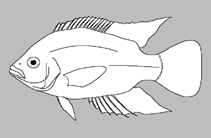
Rückenflossenstacheln (insgesamt) : 14 - 15; Rückenflossenweichstrahlen (insgesamt) : 10 - 12; Afterflossenstacheln: 3; Afterflossenweichstrahlen: 11 - 12. Diagnosis: The body depth distinguishes Diplotaxodon longimaxilla, 28.9-32.4% of standard length, from D. altus, 35.1-37.8% of standard length, D. limnothrissa, 22.5-27.8% of standard length, D. argenteus, 27.3-27.6% of standard length, and D. greenwoodi, 34.2-36.5% of standard length (Ref. 127500). Diplotaxodon longimaxilla, with horizontal eye diameter 27.1-32.1% of head length, has a smaller eye than D. macrops, horizontal eye diameter 35.2-38.2% of head length; the smaller cheek depth of D. longimaxilla, 15.2-19.4% of head length, distinguishes it from both D. aeneus, 23.2-28.1% of head length, and D. apogon, 23.2-28.0% of head length; it has more lateral-line scales than D. ecclesi, 35-38 vs. 32 (Ref. 127500).
This species is found offshore; common in trawl nets from depths below 80 m near Domira Bay (Ref. 127500).
Lebenszyklus und Paarungsverhalten
Geschlechtsreife | Fortpflanzung | Ablaichen | Eier | Fruchtbarkeit | Larven
Stauffer, J.R. Jr., T.B. Phiri and A.F. Konings, 2018. Description of two deep-water fishes of the genus Diplotaxodon (Teleostei: Cichlidae) from Lake Malawi, Africa. Proc. Biol. Soc. Wash. 131:90-100. (Ref. 127500)
IUCN Rote Liste Status (Ref. 130435: Version 2025-2 (Global))
Bedrohung für Menschen
Harmless
Nutzung durch Menschen
Tools
Zusatzinformationen
Download XML
Internet Quellen
Schätzungen auf der Grundlage von Modellen
Phylogenetischer Diversitätsindex (Ref.
82804): PD
50 = 0.5010 [Uniqueness, from 0.5 = low to 2.0 = high].
Bayesian length-weight: a=0.01445 (0.00671 - 0.03113), b=2.99 (2.82 - 3.16), in cm total length, based on LWR estimates for this (Sub)family-body shape (Ref.
93245).
Trophische Ebene (Ref.
69278): 4.1 ±0.7 se; based on size and trophs of closest relatives
Widerstandsfähigkeit (Ref.
120179): hoch, Verdopplung der Population dauert weniger als 15 Monate. (Preliminary K or Fecundity.).
Anfälligkeit der Fischerei (Ref.
59153): Low vulnerability (12 of 100).
🛈