Classificazione / Nomi
Nomi Comuni | Sinonimi | Catalog of Fishes(Genere, Specie) | ITIS | CoL | WoRMS | Cloffa
Ambiente: milieu / zona climatica / distribuzione batimetrica / gamma di distribuzione
Ecologia
; acqua dolce pelagico. Tropical
Africa: widespread in the Okavango, Cuando, upper and lower Zambezi Rivers, a region comprising southern Angola, northern Botswana, northeastern Namibia, southern tip of Malawi, southern Mozambique, and northern Zambia (Ref. 123968).
Dimensione / Peso / Età
Maturità: Lm ? range ? - ? cm
Max length : 2.4 cm SL maschio/sesso non determinato; (Ref. 123968)
Breve descrizione
Chiavi di identificazione | Morfologia | Morfometria
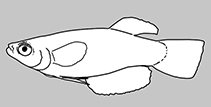
Spine dorsali (totale) : 0; Raggi dorsali molli (totale) : 6 - 8; Spine anali: 0; Raggi anali molli: 10 - 13; Vertebre: 24 - 26. Diagnosis: Lacustricola chobensis is distinguished from L. centralis, L. jobaerti, L. johnstoni, L. jubbi, L. katangae, L. macrurus, L. matthesi, L. mediolateralis, L. moeruensis, L. myaposae, L. nigrolateralis, and L. stiassnyae by the possession of banded dorsal, anal, and caudal fins in males, a conspicuous reticulate pattern on scale margins, and also by the possession of a pointed premaxilla ascending process, in which the premaxilla medial surface is slightly convex (Ref. 123968). It is distinguished from L. hutereaui by the possession of 10-13 anal-fin rays vs. 14-15; first dorsal-fin ray inserted in a vertical to the fourth or fifth anal-fin rays, vs. sixth anal-fin ray; first dorsal-fin proximal radial between 11th-12th vertebral neural spine, vs. 13th; absence of maxilla ventral sharp process, vs. presence; retroarticular about the same size as anguloarticular ventral process, vs. shorter; posteroventral extension on lachrymal, vs. rectangular, without posteroventral extension; infraorbital canal anterior portion open, with three neuromasts, vs. closed, with four pores; mandibular canal open, with two small neuromasts, vs. closed, with four pores; head neuromasts placed in shallow grooves or in the same level as head surface, vs. in deep grooves; posttemporal ventral arm not ossified, vs. ossified; cleithrum posterodorsal flap rounded, vs. sinous; and by hypural plate completely fused, vs. with a small gap, rarely fused (Ref. 123968). It is distinguished from L. petnehazyi by the presence of 10-12 anal-fin rays, vs. 14-16; first dorsal-fin ray inserted in a vertical to fourth or fifth anal-fin rays, vs. sixth to eight anal-fin rays; 22-24 scales on longitudinal line, mode 23, vs. 24-27, mode 26; 6-8 dorsal-fin rays, mode 7, vs. 8-9 dorsal-fin rays, mode 9 (Ref. 123968). It is distinguished from L. pygmaeus by the possession of 21-24 caudal-fin rays, vs. 26-30; an elliptical caudal fin in males, vs. rounded; chromatophores along whole mid-body line of flank, forming a conspicuous line, vs. inconspicuous; 6-8 dorsal-fin rays, vs. 10-12; first dorsal-fin ray inserted in a vertical to the fourth or fifth anal-fin rays, vs. second and third anal-fin ray; and by the absence of a concavity on quadrate posterior margin, vs. presence (Ref. 123968).
Found in swampy and riverine environments close to marginal vegetation (Ref. 123968).
Ciclo vitale e comportamento di accoppiamento
Maturità | Riproduzione | Deposizione | Uova | Fecondità | Larve
De Bragança, P.H.N., P.H. Skelton, R. Bills, D. Tweddle and A. Chakona, 2021. Revalidation and redescription of "Lacustricola" chobensis (Fowler, 1935) and description of a new miniature species of "Lacustricola" from southern Africa (Cyprinodontiformes: Procatopodidae). Ichthyol. Herpetol. 109(1):123-137. (Ref. 123968)
Stato della Lista Rossa IUCN (Ref. 130435: Version 2025-2 (Global))
Minaccia per l'uomo
Harmless
Usi umani
Strumenti
Rapporti speciali
Scarica XML
Fonti Internet
Stime basate su modelli
Indice di diversità filogenetica (Fonte Biblio.
82804): PD
50 = 0.5000 [Uniqueness, from 0.5 = low to 2.0 = high].
Bayesian length-weight: a=0.01122 (0.00514 - 0.02450), b=3.04 (2.87 - 3.21), in cm total length, based on all LWR estimates for this body shape (Ref.
93245).
Livello trofico (Fonte Biblio.
69278): 3.0 ±0.3 se; based on size and trophs of closest relatives
Vulnerabilità della pesca (Ref.
59153): Low vulnerability (10 of 100).
🛈