Klassificering / Namn
Populärnamn | synonymer | Catalog of Fishes(Släkte, Arter) | ITIS | CoL | WoRMS | Cloffa
>
Siluriformes (Catfishes) >
Heptapteridae (Three-barbeled catfishes)
Etymology: Heptapterus: Greek, epta = seven + Greek, pteron = wing, fin (Ref. 45335); carmelitanorum: Name from Carmelitanos (Portuguese), the local appellation of people born or living in Carmo do Rio Claro, Minas Gerais, Brazil (where the species was discovered) and especially in honor of Ana Maria Vilela Soares, José Cândido de Mello Carvalho, Moara Lemos, and Carlos Roberto Bueno Júnior, for their contributions to biological science: noun in apposition.
Miljö: miljö / Klimatzon / djupintervall / distributionsområde
Ekologi
marina bottenlevande; djupintervall 0 - 1 m (Ref. 127242). Tropical
South America: Brazil.
Storlek / Vikt / Ålder
Könsmognad: Lm ? range ? - ? cm
Max length : 14.4 cm SL hane/ej könsbestämd; (Ref. 127242)
Kort beskrivning
Bestämningsnycklar | Morfologi | Morfometri
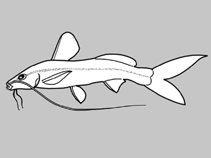
This species is distinguished from its congeners by the following characters: anal-fin insertion less than one eye diameter posterior to a vertical through the adipose-fin insertion (vs. more than one eye diameter posterior); differs from all congeners, except H. borodini, by having an isognathous mouth (vs. slightly to moderately retrognathous); differs from all congeners except H. borodini and H. hollandi, by the keel formed by ventral procurrent caudal-fin rays shallow, far from reaching anal-fin base (vs. keel formed by ventral procurrent caudal-fin rays deep, continuing almost to the anal-fin base, even though its anterior part is devoid of fin rays); differs from H. borodini and H. hollandi by having an almost elliptical caudal fin (vs. lanceolate in H. borodini, obliquely truncate to falcate in H. hollandi; length of its dorsal lobe 18.3-19.3% SL (vs. 24.4-43.3% SL in H. borodini); differs from congeners, except carnatus, mbya, qenqo, and some specimens of H. hollandi, by having inconspicuous dorsal bars (vs. conspicuous); differs borodini, carnatus, exilis, hollandi, mustelinus, ornaticeps, by having 14-15 anal-fin rays (vs. 10-12 in borodini, hollandi; 18-21 in H. carnatus; 16-19 in H. exilis; 18-23 in H. mustelinus; and 19 in H. ornaticeps); differs from H. exilis by having a complete lateral line (in adults), continuous to base of hypural plate (vs. incomplete, not reaching dorsal-fin insertion); differs further from H. hollandi by having i,6 dorsal-fin rays (vs. i,7) (Ref. 127242).
Cross section: oval.
Collection area with the water extremely clear (small characids readily observed) and
well oxygenated. The stream was shallow (not exceeding 1 meter), and its bed was completely formed by rocks; light penetration was low during samplings. the reach, submerged tree roots and accumulated leaves and fruits (especially Fabaceae) formed some microhabitats for some species, notably Trichomycterus candidus and Cetopsorhamdia iheringi, Specimens of this species were captured in environments that combined rocks (generally juxtaposed) and a more turbulent flow. The species is apparently demersal upon observation sampling. The species was collected with C. iheringi, Hoplias malabaricus, Knodus moenkhausii, Odontostilbe weitzmani, Oligosarcus argenteus, Pareiorhina sp., Psalidodon sp., T. candidus, T. septemradiatus (Ref.
Livscykel och parningsbeteende
Könsmognad | Reproduktion | Lek | Ägg | Fekunditet | Larver
Deprá, G. de Carvalho, G. Aguilera, D.R. Faustino-Fuster, A.M. Katz and V.M. Azevedo-Santos, 2022. Redefinition of Heptapterus (Heptapteridae) and description of Heptapterus carmelitanorum, a new species from the upper Paraná River basin in Brazil. Zoosyst. Evol. 98(2):327-343. (Ref. 127242)
Status på IUCN:s rödlista (Ref. 130435: Version 2025-2 (Global))
Hot mot människor
Harmless
Mänskliga användningsområden
Verktyg
Särskilda rapporter
Ladda ner XML
Internet-källor
Uppskattningar baserade på modeller
Index för fylogenetisk mångfald (Ref.
82804): PD
50 = 0.5002 [Uniqueness, from 0.5 = low to 2.0 = high].
Bayesian length-weight: a=0.00813 (0.00379 - 0.01743), b=2.97 (2.79 - 3.15), in cm total length, based on LWR estimates for this (Sub)family-body shape (Ref.
93245).
Trofisk nivå (Ref.
69278): 3.5 ±0.4 se; based on size and trophs of closest relatives
Resiliens (Ref.
120179): Låg, lägsta populationsfördubblingstid 4,5-14 år (Preliminary K or Fecundity.).
Sårbarhet i fisket (Ref.
59153): Low vulnerability (10 of 100).
🛈