Elasmobranquios (tiburones y rayas) (sharks and rays) >
Squaliformes (Sleeper and dogfish sharks) >
Somniosidae (Sleeper sharks)
Etymology: Scymnodalatias: scymno-, referring to previous placement in Scymnodon; dalatias, referring to lack of dorsal spines like most sharks in the family Dalatiidae (sometimes included within Somniosidae) (See ETYFish); sherwoodi: In honor of C. W. Sherwood, who discovered the shark washed up on a beach in Canterbury, New Zealand, and presented it to the local museum (See ETYFish).
Eponymy: C W Sherwood discovered the holotype lying washed up on the beach at New Brighton, New Zealand (1920) and presented it to the Canterbury Museum. Nothing further was recorded. (Ref. 128868), visit book page.
Entorno: milieu / zona climática / rango de profundidad / gama de distribución
Ecología
marino bentopelágico. Subtropical; 42°S - 44°S
Distribución
Territorios | Áreas FAO | Ecosistemas | Ocurrencias, apariciones | Mapa de puntos | Introducciones | Faunafri
Southwest Pacific: New Zealand. Possibly occurring off Australia (Ref. 6871).
Tamaño / Peso / Edad
Madurez: Lm ? range ? - ? cm
Max length : 80.3 cm TL macho / no sexado; (Ref. 247)
Descripción breve
Claves de identificación | Morfología | Morfometría
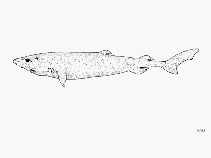
Espinas dorsales (total) : 0. Dark brown or black with a grey blaze on the back behind the eyes (Ref. 26346). Scymnodon-like, but with no dorsal spines and the first dorsal fin slightly more posterior than in Scymnodon species; snout somewhat flattened, not bulbous, lower teeth with very high, erect or semi-erect cusps, distal blades and no serrations, first dorsal on middle of back behind pectoral fins, caudal fin asymmetrical, with a short lower lobe, fins without prominent light edges (Ref. 247).
Body shape (shape guide): elongated.
A rare species (Ref. 26346) presumably inhabiting the insular slope of New Zealand (Ref. 247). Ovoviviparous (Ref. 205).
Ciclo vital y comportamiento de apareamiento
Madurez | Reproducción | Puesta | Huevos | Fecundidad | Larva
Distinct pairing with embrace (Ref. 205).
Compagno, L.J.V., 1984. FAO Species Catalogue. Vol. 4. Sharks of the world. An annotated and illustrated catalogue of shark species known to date. Part 1 - Hexanchiformes to Lamniformes. FAO Fish. Synop. 125(4/1):1-249. Rome, FAO. (Ref. 247)
Situación en la Lista Roja de la UICN (Ref. 130435: Version 2025-2 (Global))
Amenaza para el ser humano
Harmless
Usos humanos
Pesquerías: sin interés
Herramientas
Informes especiales
Descargar XML
Fuentes de Internet
Estimaciones basadas en modelos
Índice de diversidad filogenética (Referencia
82804): PD
50 = 0.5625 [Uniqueness, from 0.5 = low to 2.0 = high].
Bayesian length-weight: a=0.00398 (0.00172 - 0.00922), b=3.13 (2.94 - 3.32), in cm total length, based on LWR estimates for this (Sub)family-body shape (Ref.
93245).
Nivel trófico (Referencia
69278): 4.0 ±0.4 se; based on size and trophs of closest relatives
Resiliencia (Referencia
120179): Bajo, población duplicada en un tiempo mínimo de 4.5-14 años (Fec assumed to be <100).
Vulnerabilidad pesquera (Ref.
59153): Moderate to high vulnerability (52 of 100).
🛈
Nutrientes (Ref.
124155): Calcium = 15 [3, 74] mg/100g; Iron = 0.552 [0.142, 1.667] mg/100g; Protein = 19.7 [17.4, 22.0] %; Omega3 = 0.27 [0.10, 0.78] g/100g; Selenium = 27.5 [7.9, 98.4] μg/100g; VitaminA = 31.4 [7.8, 139.6] μg/100g; Zinc = 0.658 [0.308, 1.290] mg/100g (wet weight);