>
Gobiiformes (Gobies) >
Gobiidae (Gobies) > Gobiinae
Etymology: Eviota: No etymology given, suggested by Christopher Scharpt: from Latin 'eu' for 'true' and 'iota' for anything very small, in combination 'truly very small' referring to it as being the smallest vertebrate at the time it has benn described by Jenkins (thus, making the suggestion by Scharpt plausible; oculineata: Name from Latin 'oculi; for eye and 'linea' for line or stripe, referring to the stripes through the eye, which distinguish this species from E. cometa; an adjective.
Entorno: milieu / zona climática / rango de profundidad / gama de distribución
Ecología
marino asociado a arrecife; rango de profundidad 1 - 35 m (Ref. 126577), usually 20 - 35 m (Ref. 126577). Tropical
Western Pacific: New Guinea and the Solomon Is.; possibly in Fiji, Indonesia (Banda Sea), and Australia (Great Barrier Reef).
Tamaño / Peso / Edad
Madurez: Lm ? range ? - ? cm
Max length : 1.1 cm SL macho / no sexado; (Ref. 126577)
Descripción breve
Claves de identificación | Morfología | Morfometría
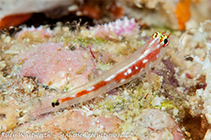
Espinas dorsales (total) : 7; Radios blandos dorsales (total) : 8; Espinas anales: 1; Radios blandos anales: 7. This species is distinguished by the following: body depth ca. 27-31% SL; pectoral-fin rays usually 14; cephalic sensory-canal pore pattern lacking only the IT pore, AITO small and opening dorsally; pectoral-fin rays unbranched; dorsal/anal-fin formula 8/7; fifth pelvic-fin ray 8-15% of 4th ray. Colouration: with a large and dark oval spot on area of preural centrum connected to a short, vertically elongate spot over end of hypural plate; caudal fin of freshly dead specimens with no prominent vertical bars; naris long and reddish brown; side of body with prominent red lateral streak bordered dorsally by 3-5 elongate white dashes; eye with two distinct horizontal stripes, one white crossing through lower margin of pupil, the other yellow crossing upper margin of pupil (Ref. 126557).
Cross section: oval.
This species apparently prefers outer reef slopes exposed to clear oceanic water and is frequently observed resting individually on coralline algae outcrops or live plate corals (Ref. 126577).
Ciclo vital y comportamiento de apareamiento
Madurez | Reproducción | Puesta | Huevos | Fecundidad | Larva
Tornabene, L., D.W. Greenfield and M.V. Erdmann, 2021. A review of the Eviota zebrina complex, with descriptions of four new species (Teleostei, Gobiidae). ZooKeys 1057:149-184. (Ref. 126577)
Situación en la Lista Roja de la UICN (Ref. 130435: Version 2025-2 (Global))
Amenaza para el ser humano
Harmless
Usos humanos
Herramientas
Informes especiales
Descargar XML
Fuentes de Internet
Estimaciones basadas en modelos
Índice de diversidad filogenética (Referencia
82804): PD
50 = 0.5000 [Uniqueness, from 0.5 = low to 2.0 = high].
Bayesian length-weight: a=0.00692 (0.00281 - 0.01706), b=3.09 (2.92 - 3.26), in cm total length, based on LWR estimates for this Genus-body shape (Ref.
93245).
Nivel trófico (Referencia
69278): 2.9 ±0.3 se; based on size and trophs of closest relatives
Resiliencia (Referencia
120179): Alto, población duplicada en un tiempo mínimo inferior a 15 meses (Preliminary K or Fecundity.).
Vulnerabilidad pesquera (Ref.
59153): Low vulnerability (10 of 100).
🛈