
Mastacembelus kadeiensis

You can sponsor this page

Mastacembelus kadeiensis Roberts, 2020

アップロード 写真 そして ビデオ
グーグルの画像
Image of Mastacembelus kadeiensis
No image available for this species;
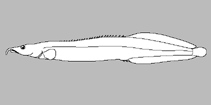
drawing shows typical species in Mastacembelidae.

分類 / 名前 共通名の | 類義語 | Catalog of Fishes(部類, ) | ITIS | CoL | WoRMS | Cloffa

> Synbranchiformes (Spiny eels) > Mastacembelidae (Spiny eels)
Etymology: Mastacembelus: Greek, mastax, -agos = bite + Greek, emballo = to throw oneself (Ref. 45335).

環境:環境 / 気候帯 / 深さの範囲 / 分布範囲 生態学

; 新鮮な水 底生の漂泳性. Tropical

分布 領土 | 国連食糧農業機関の区域 | エコシステム | 事件 | 目的のマップ | 導入 | Faunafri

Africa: Kadei River, Congo River basin, in Central African Republic (Ref. 123814).

サイズ / 重さ / 年齢

成熟: Lm ?  range ? - ? cm
Max length : 14.3 cm SL オス/雌雄の選別がない; (Ref. 123814)

簡単な記述 検索表 | 形態学 | 形態計測学

背面の脊椎 (合計) : 19; 背鰭 (合計) : 95; 肛門の骨: 3; 臀鰭: 81; 脊つい: 85. Diagnosis: Mastacembelus kadeiensis differs from all other species of Mastacembelus in having 19 dorsal-fin spines; dorsal fin origin on vertebra 6; first dorsal fin pterygiophore without spine, articulating with neural spine of vertebra 6; base of first dorsal-fin spine above vertebra 8, base of last dorsal fin spine above vertebra 28, base of first anal fin spine below vertebrae 31, above 8 and 22, and below 33 in Mastacembelus sexdecimspinus; branchiostegal rays 4, usually 6 in other Mastacembelus; dorsal-fin rays 95; anal-fin spines 3, 2 much stouter and longer than 1 and 3; anal-fin rays 81; principal caudal-fin rays 5/6, no upper or lower procurrent rays; vertebrae 28+57=85 (Ref. 123814). Most similar species of Mastacembelus kadeiensis is M. sexdecimspinus; it differs from M. sexdecimspinus in having dorsal fin spines 19, vs. 15-16; dorsal-fin rays 95, vs. 112-132; anal-fin rays 81, vs. 81-98; origin of dorsal-fin soft rays above vertebrae 29, of anal-fin soft rays below 35, vs. above vertebra 23 and below 35; vertebrae 28+57=85, vs. 30+58=88 (Ref. 123814). Both have spiny dorsal fin origin above vertebra 6, apparently 4 branchiostegal rays, and 5/6 principal caudal-fin rays; colouration markedly different; that of M. kadeiensis can be compared to that of a typically-coloured M. sexdecimspinus which has entire head and body with dark background colouration closely covered with rows of numerous large roundish pale spots; such colouration is continuous over the entire dorsal and anal fins, lacking a thin white margin, and on ventral surface of head and abdomen which are much lighter in colouration overall; pectoral fin with smaller dark mark near its base and two thin broken vertical bars on its middle (Ref. 123814).

Colouration: Live colouration not recorded (Ref. 123814). Colouration of preserved specimens highly distinctive, most notably with a series of bilateral pairs of small round white spots on each side for entire length of dorsum, and 14 bold obliquely-oriented white slash marks on ventral part of body on either side just above anal fin base; dorsal surface of head to well below eye and upper half of gill cover and entire lateral surface of body uniformly dark coloured, without pale marks or pattern; ventral half of head and abdomen entirely pale, without marks or pattern, then a series of ten large sharply defined roundish or oval pale spots on either side of body above anal fin base; dorsal and anal fins darkish overall, with thin white margin; pectoral fin pale overall, with large dark blotch on its base and two thin dark vertical bars in its middle (Ref. 123814).

生物学     用語集 (例 epibenthic)

ライフサイクルと交尾行動 成熟 | 繁殖 | 放精 | | 生産力 | 幼生

主な参考文献 参考文献のアップロード | 参考文献 | コーディネーター | 協力者

Roberts, T.R., 2020. Two new species of the spiny percheel genus Mastacembelus (Synbranchiformes, Mastacembelidae) with low numbers of dorsal fin spines from the Congo basin. Aqua, Int. J. Ichthyol., 26(3-4):69-76. (Ref. 123814)

IUCNのレッドリストの状況は (Ref. 130435: Version 2025-2 (Global))


CITES

Not Evaluated

CMS (Ref. 116361)

Not Evaluated

人間に対する脅威

  Harmless


人間の用途

FAO - Publication: search | FishSource |

より多くの情報

養殖生態
食料品(獲物)
餌の構成
摂食量
食料配給
捕食動物
生態学
生態学
人口動態
成長のパラメーター
最大年齢/サイズ
長さ-重量比。
長短関係。
体長組成
質量変換
補充
豊度
ライフサイクル
繁殖
成熟
成熟度/エラ
生産力
放精
産卵群

卵の開発
幼生
幼生の動力
分布
領土
国連食糧農業機関の区域
エコシステム
事件
導入
BRUVS - ビデオ
解剖学
カマ

オトリス
生理学
体組成
栄養素
酸素消費
水泳タイプ
泳ぐ速さ
視覚色素
フィッシュ・サウンド
病気と寄生虫
毒性(LC50)
遺伝子の
ゲノム
遺伝子の
ヘテロ接合性
遺伝
遺伝的多様性
人間関係
養殖システム
水産養殖の紹介
緊張
シガテラ症例
切手、コイン、その他
アウトリーチ
協力者
分類学
共通名の
類義語
形態学
形態計測学
画像
参考文献
参考文献

用具

特記事項

XMLをダウンロードして下さい

インターネットの情報源

AFORO (otoliths) | Aquatic Commons | BHL | Cloffa | Websites from users | Check FishWatcher | CISTI | Catalog of Fishes: 部類, | DiscoverLife | ECOTOX | FAO - Publication: search | Faunafri | Fishipedia | Fishtrace | GloBI | Google Books | Google Scholar | Google | IGFA World Record | OneZoom | Open Tree of Life | Otolith Atlas of Taiwan Fishes | PubMed | Reef Life Survey | Socotra Atlas | TreeBase | 生命の木 | Wikipedia: 行く, 検索する | World Records Freshwater Fishing | Zoobank | 動物に関する記録

モデルに基づく推定値

系統多様性指数 (参照 82804):  PD50 = 0.5000   [Uniqueness, from 0.5 = low to 2.0 = high].
Bayesian length-weight: a=0.00269 (0.00129 - 0.00562), b=2.94 (2.76 - 3.12), in cm total length, based on LWR estimates for this (Sub)family-body shape (Ref. 93245).
栄養段階 (参照 69278):  3.6   ±0.6 se; based on size and trophs of closest relatives
回復力 (参照 120179):  高い, 15か月以下の倍増期間の最小個体群 (Preliminary K or Fecundity.).
漁業の脆弱性 (Ref. 59153):  Low vulnerability (10 of 100). 🛈