This website uses cookies to enhance your browsing experience and ensure the functionality of our site. For more detailed information about the types of cookies we use and how we protect your privacy, please visit our Privacy Information page.
×
Cookie Settings
This website uses different types of cookies to enhance your experience. Please select your preferences below:
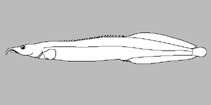
背棘 (總數) : 10; 背的軟條 (總數) : 101; 脊椎骨: 81. Diagnosis: Mastacembelus ubangipaucispinis is most similar to M. paucispinis in having 10 dorsal-fin spines, vs. 6-10, only 101 soft dorsal-fin rays, vs. 115-123, in having a well-developed colour pattern instead of a colouration largely reduced or absent in some specimens (Ref. 123814). Base of first dorsal-fin spine above vertebra 7, base of last dorsal fin spine above vertebra 17, base of first anal-fin spine below vertebrae 31, vs. 6 and 14, and below 30 in M. paucispinis; vertebrae 27+54=81, vs. 28-29+51-55=80-84 in M. paucispinis; to the extent colouration of M. paucispinis is visible it resembles that of M. ubangipaucispinis, particularly in the presence of about 15 small dark spots along the dorsal-fin base, and faint vertical bars on the side of the body for its entire length (Ref. 123814). Similarities of M. ubangipaucispinis and M. paucispinis: the uniquely low number of dorsal-fin spines shared by M. ubangipaucispinis and M. paucispinis, beginning only four or five to probably 6 or 7 vertebrae behind the head and followed by over 100 dorsal-fin rays, is evidence that these two species are each other's closest relatives, as is the persistence of similarities in the reduced or obsolescent colour pattern of M. paucispinis to the well-developed colouration of M. ubangipaucispinis; that they are distinct species is supported by M. ubangipaucispinis having only 101 dorsal fin rays instead of 115-123 (Ref. 123814). So far as known no Mastacembelus species with 6-10 dorsal-fin spines occurs in the upper rapids of the Congo mainstream above Kisangani; retention of full colouration and its lower dorsal fin ray count might suggest, although highly speculative, that M. ubangipaucispinis reperesents the ancestral species of M. paucispinis, and that it evolved from individuals of M. ubangipaucispinis carried downstream from rapids of the Ubangi River to rapids of the mainstream Congo below Kinshasa (Ref. 123814).
Roberts, T.R., 2020. Two new species of the spiny percheel genus Mastacembelus (Synbranchiformes, Mastacembelidae) with low numbers of dorsal fin spines from the Congo basin. Aqua, Int. J. Ichthyol., 26(3-4):69-76. (Ref. 123814)
系統發育多樣性指數 (參考文獻 82804): PD50 = 0.5000 [Uniqueness, from 0.5 = low to 2.0 = high].
Bayesian length-weight: a=0.00269 (0.00129 - 0.00562), b=2.94 (2.76 - 3.12), in cm total length, based on LWR estimates for this (Sub)family-body shape (Ref. 93245).
營養階層 (參考文獻 69278): 3.7 ±0.6 se; based on size and trophs of closest relatives
回復力 (參考文獻 120179): 高度, 族群倍增時間少於 15個月 (Preliminary K or Fecundity.).
釣魚的脆弱性 (Ref. 59153): Low vulnerability (15 of 100). 🛈