Classificazione / Nomi
Nomi Comuni | Sinonimi | Catalog of Fishes(Genere, Specie) | ITIS | CoL | WoRMS | Cloffa
Ambiente: milieu / zona climatica / distribuzione batimetrica / gamma di distribuzione
Ecologia
marino demersale; distribuzione batimetrica ? - 60 m (Ref. 114953). Tropical
Western Pacific: Indo-Malay Arch., Indonesia (Nusa Tenggara) to Taiwan, including the Philippines.
Dimensione / Peso / Età
Maturità: Lm ? range ? - ? cm
Max length : 220 cm TL maschio/sesso non determinato; (Ref. 114953)
Breve descrizione
Chiavi di identificazione | Morfologia | Morfometria
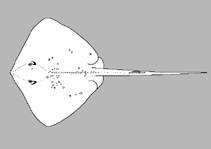
This medium sized whipray is distinguished by the following characters: disc rhombic, small head (39-41% WD); internasal width 8.3-8.8% WD; small oval to heart-shaped mid-shoulder denticle, with obvious denticle band in adults; tail whip-like without skin folds, upper surface variably white-spotted; disc rather flat, wider than long, length 76-87% WD; pectoral-fin apex rounded to somewhat angular; snout broad with enlarged triangular apical lobe, the anterior margins weakly concave; eyes are small and potruding slightly, length of orbit and spiracle ca. 2 in snout length, interorbital space 1.9-2 times the orbit length; mouth arched, 2-5 oral papillae (medial pair enlarged); labial furrows and folds are prominent; lower jaw arched slightly; nasal curtain is subrectangular, the posterior margin finely fringed; mid-shoulder denticle small and only slightly larger than smaller denticles adjacent; in adults the denticle band is well-developed with slow development in young; tail is very long and slender, 2.8-3.4 times WD in length; slightly depressed in cross-section and tapering gently and evenly toward caudal sting, then weakly beyond the sting; with usually one caudal sting; tail beyond caudal sting is sparsely covered with denticles (Ref. 114953).
Cross section: flattened.
This species is mainly benthic on soft bottoms, from inshore to at least 60 m. Feeds mainly on small prawns. Size to at least 85 cm WD or 220 cm TL. Males mature at ca. 46-48 cm WD while females at about 64 cm WD, born at ca. 18 cm WD (Ref. 114953).
Ciclo vitale e comportamento di accoppiamento
Maturità | Riproduzione | Deposizione | Uova | Fecondità | Larve
Last, P.R., W.T. White, M.R. de Carvalho, B. Séret, M.F.W. Stehmann and G.J.P. Naylor, 2016. Rays of the world. CSIRO Publishing, Comstock Publishing Associates. i-ix + 1-790. (Ref. 114953)
Stato della Lista Rossa IUCN (Ref. 130435: Version 2025-2 (Global))
Minaccia per l'uomo
Harmless
Usi umani
Strumenti
Rapporti speciali
Scarica XML
Fonti Internet
Stime basate su modelli
Indice di diversità filogenetica (Fonte Biblio.
82804): PD
50 = 0.5020 [Uniqueness, from 0.5 = low to 2.0 = high].
Bayesian length-weight: a=0.01023 (0.00482 - 0.02174), b=3.06 (2.86 - 3.26), in cm total length, based on LWR estimates for this (Sub)family-body shape (Ref.
93245).
Livello trofico (Fonte Biblio.
69278): 3.7 ±0.4 se; based on size and trophs of closest relatives
Vulnerabilità della pesca (Ref.
59153): Very high vulnerability (90 of 100).
🛈