This website uses cookies to enhance your browsing experience and ensure the functionality of our site. For more detailed information about the types of cookies we use and how we protect your privacy, please visit our Privacy Information page.
×
Cookie Settings
This website uses different types of cookies to enhance your experience. Please select your preferences below:
分類 / 名稱 俗名 | 同種異名 | Catalog of Fishes(屬, 種) | ITIS | CoL | WoRMS | Cloffa
Elasmobranchii 板鰓亞綱 (鯊魚與魟魚) (sharks and rays) > Myliobatiformes (Stingrays) 鰩目 (Stingrays) > Dasyatidae (Stingrays) 土魟科 (Stingrays) > Dasyatinae
Etymology: berthalutzae:Named for Bertha Lutz, a pioneering Brazilian woman zoologist, who was also involved in feminist issues and created the Brazilian Federation for Feminine Progress; alluding to this species restricted to the Brazilian waters and since most known specimens are females, it represents the recent feminine empowering, including in sciences. Eponymy: Bertha Maria Júlia Lutz (1894–1976) was a Brazilian zoologist, politician and pioneering feminist, who founded the Brazilian Federation for Feminine Progress (1922). [...] (Ref. 128868), visit book page.
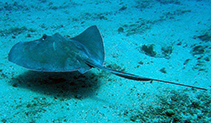
This species is distinguished from non-Hypanus species that occur in the western Atlantic by the presence of dorsal a caudal ridge (vs. absence in Bathytoshia centroura, a dorsal caudal fold in Dasyatis hypostigma); absence of a w-shaped notch in the central ventral disc (vs. presence in D. hypostigma); and with the anterior portion of the disc with angle varying from 125°-135° and a clear ventral disc (vs. 150° and dark ventral disc in Pteroplatytrygon violacea). It differs from most Hypanus species, except those from the H. americanus species group, it can be distinguished by the diamond-shaped body with a short snout (vs. long snout in H. guttatus, H. sabinus); presence of ventral caudal fold and dorsal caudal ridge (vs. ventral and dorsal caudal folds in H. marianae, H. dipterurus, H. say, H. sabinus); a white spot between the eyes anterior to the precerebral fontanelle (vs. absent in H. marianae, H. guttatus, H. dipterurus, H. say, H. sabinus); differs from the species of the H. americanus clade (H. americanus, H. longus, H. rudis) by the presence of sparse black spots on the dorsal disc of live specimens (vs. absent) and by 11 morphometric measurements, the most relevant being spiracle length or SPL [18.62% (16.21%-22.47%) of head length or HDL vs. 19.61% (15.85%-32.81%) in H. americanus, 18.37% (17.03%-21.89%) in H. longus and 24.79% (23.55%-26.11%) in H. rudis] and ventral caudal fold height or VFH [1.92% (1.37%-2.3%) of DW vs. 1.74% (0.83%-2.83%) in H. americanus, 1.39% (0.75%-2.71%) in H. longus and 1.55% (1.1%-1.81%) in H. rudis]. In male adults of H. berthalutzae and H. americanus, the pelvic fin length or P2L is smaller than the distance from apopyle to clasper tip (ap-tip), whereas it is larger in H. longus. The measurement P2L/ap-tip is 54.16% in H. berthalutzae [vs. 49.43% (41.78%-56.33%) in H. americanus and 119.44% (113.20%-124.15%) in H. longus] (Ref. 123757). Cross section: flattened.
Mostly a coastal species, usually at the continental shelf, and reported to occur in localities up to 250 km off the coast (Ref. 123757).
Petean, F.F., G.J.P. Naylor and S.M.Q. Lima, 2020. Integrative taxonomy identifies a new stingray species of the genus Hypanus Rafinesque, 1818 (Dasyatidae, Myliobatiformes) from the Tropical Southwestern Atlantic. J. Fish Biol. 97(4):1120-1142. (Ref. 123757)
系統發育多樣性指數 (參考文獻 82804): PD50 = 0.5010 [Uniqueness, from 0.5 = low to 2.0 = high].
Bayesian length-weight: a=0.00447 (0.00189 - 0.01058), b=3.12 (2.92 - 3.32), in cm total length, based on LWR estimates for this (Sub)family-body shape (Ref. 93245).
營養階層 (參考文獻 69278): 3.5 ±0.5 se; based on size and trophs of closest relatives
釣魚的脆弱性 (Ref. 59153): Very high vulnerability (90 of 100). 🛈