Классификация / Имена
народные названия | синонимы | Catalog of Fishes(род, виды) | ITIS | CoL | WoRMS | Cloffa
>
Cichliformes (Cichlids, convict blennies) >
Cichlidae (Cichlids) > Pseudocrenilabrinae
Etymology: Haplochromis: Greek, Haploos = single + Greek, chromis = a fish, perhaps a perch (Ref. 45335); aquila: Specific name from the Latin 'aquila' for 'eagle'; referring to predatory morphology and large eyes (Ref. 126312).
Окружающая среда: среда / климатическая зона / пределы глубины / диапазон распространения
экология
; пресноводный пелагический. Tropical
Africa: Lake Edward (Ref. 126312).
Размер / Вес / Возраст
половая зрелость: Lm ? range ? - ? cm
Max length : 12.3 cm SL самец/пол неопределен; (Ref. 126312)
Краткое описание
определительные ключи | морфология | морфометрия
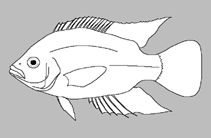
колючие лучи спинного плавника (общее число) : 14 - 16; членистые (мягкие) лучи спинного плавника (общее число) : 9 - 10; колючие лучи анального плавника: 3; членистые (мягкие) лучи анального плавника: 8 - 9; позвонки: 30. Diagnosis: Species with a piscivorous morphology; eye large, eye diameter 30.0-31.5% of head length; outer oral teeth few and large, 25-37; dominant males light grey with a black head and a bright red anal fin (Ref. 126312). Amongst piscivorous species from the Lake Edward system, H. aquila differs from H. latifrons, H. mentatus, H. rex, H. simba, and H. glaucus by a larger eye, eye diameter 30.0-31.5% of head length vs. 22.2-29.9%; it further differs from H. latifrons and H. mentatus by a shorter caudal peduncle, caudal peduncle length 14.6-15.4% of standard length vs. 15.7-18.0%; further from H. latifrons by the absence vs. presence of a well-defined mid-lateral band; further from H. mentatus by dominant males uniformly light grey vs. yellow-green with a red anterior part of flank; it further differs from H. rex by a shallower lacrimal, lacrimal depth 17.0-19.1% of head length vs. 18.9-22.5%; and dominant males light grey with black operculum and snout vs. cream-coloured with an orange operculum and a light blue snout; it further differs from H. simba by a larger number of scales between first anal-fin spine and upper lateral line, 12-15, raraely 11, vs. 9-11; an absent vs. strongly developed mental prominence; and dominant males light grey with a black head vs. uniformly yellow with an orange anterior part of flank; it further differs from H. glaucus by a broader head, head width 40.1-43.7% of head length vs. 38.9-40.9%; and dominant males light grey with bright red anal and caudal fins vs. light blue with crimson anal and caudal fins (Ref. 126312). It differs from H. kimondo, H. falcatus, H. curvidens, H. pardus, H. quasimodo and H. squamipinnis by the combination of large vs. small outer oral teeth and smaller number of outer upper jaw teeth, 25-37 vs. 39-79; it further differs from H. kimondo, H. falcatus and H. quasimodo by absence vs. mostly presence of a well-defined mid-lateral band and dominant males light grey with a black head vs. grey dorsally and yellow ventrally, olive-green with an orange-red anterior part of flank, or light grey dorsally and blue-black ventrally; further from H. kimondo by a narrower head, head width 40.1-43.7% of head length vs. 42.9-48.0%; it further differs from H. curvidens and H. pardus by a deeper cheek, cheek depth 26.8-30.8% of head length vs. 20.8-24.9%; further from H. pardus by dominant males light grey vs. speckled to uniformly black; it further differs from H. squamipinnis by larger eyes, eye diameter 30.0-31.5% of head length vs. 23.1-29.7%; and dominant males light grey vs. slate blue (Ref. 126312).
Found in inshore areas over muddy substrates (Ref. 126312). Based on its morphology, most probably a piscivorous species (Ref. 126312).
Жизненный цикл и брачное поведение
половая зрелость | размножение | нерест | икра | Плодовитость | личинки
Vranken, N., M. Van Steenberge, A. Heylen, E. Decru and J. Snoeks, 2022. From a pair to a dozen: the piscivorous species of Haplochromis (Cichlidae) from the Lake Edward system. Eur. J. Taxon. 815:1-94. (Ref. 126312)
Статус Красного Списка МСОП (Ref. 130435: Version 2025-2 (Global))
Угроза для людей
Harmless
Использование человеком
дополнительная информация
инструменты
Специальные отчеты
Скачать в формате XML
ресурсы в Интернет
Оценки, основанные на моделях
Индекс филогенетического разнообразия (ссылка
82804): PD
50 = 0.5000 [Uniqueness, from 0.5 = low to 2.0 = high].
Bayesian length-weight: a=0.01445 (0.00671 - 0.03113), b=2.99 (2.82 - 3.16), in cm total length, based on LWR estimates for this (Sub)family-body shape (Ref.
93245).
Трофический уровень (ссылка
69278): 3.4 ±0.4 se; based on size and trophs of closest relatives
устойчивость к внешним воздействиям (ссылка
120179): высокий, минимальное время удвоения популяции до 15 месяцев (Preliminary K or Fecundity.).
Уязвимость рыбной ловли (Ref.
59153): Low vulnerability (10 of 100).
🛈