Classificação / Nomes
Nomes comuns | Sinônimos | Catalog of Fishes(Gênero, Espécies) | ITIS | CoL | WoRMS | Cloffa
>
Cichliformes (Cichlids, convict blennies) >
Cichlidae (Cichlids) > Pseudocrenilabrinae
Etymology: Haplochromis: Greek, Haploos = single + Greek, chromis = a fish, perhaps a perch (Ref. 45335); glaucus: Specific name from the Latin 'glaucus' for 'greyish blue'; referring to grey and light-blue colour pattern of all adult specimens (Ref. 126312).
Meio ambiente: milieu / Zona climática / intervalo de profundidade / faixa de distribuição
Ecologia
; Água doce pelágico(a,os,as). Tropical
Africa: Lake Edward (Ref. 126312).
Tamanho / Peso / Idade
Maturidade: Lm ? range ? - ? cm
Max length : 15.8 cm SL macho/indeterminado; (Ref. 126312)
Descrição suscinta
Chaves de identificação | Morfologia | Morfometria
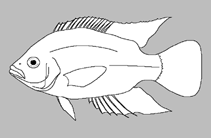
Espinhos dorsais (total) : 14 - 16; Raios dorsais (total) : 9 - 10; Espinhos anais: 3; Raios anais : 8 - 10; Vértebras: 29 - 30. Diagnosis: Species with a piscivorous morphology; snout acute in lateral view; outer oral teeth few and large, 25-47; males grey with light blue flank and a dusky to black head; female colour pattern similar to males (Ref. 126312). Amongst piscivorous species from the Lake Edward system, H. glaucus differs from H. latifrons and H. mentatus by a shorter caudal peduncle, caudal peduncle length 13.4-16.1% of standard length vs. 15.7-18.0%; further from H. latifrons by a longer anal fin base, 17.3-20.3% of standard length vs. 14.7-17.3%; and absence vs. presence of a well-defined mid-lateral band; further from H. mentatus by a broader lower pharyngeal bone, lower pharyngeal width 93.3-95.1% of lower pharyngeal length vs. 83.6-85.7%; a slightly longer pre-pectoral distance, 36.4-39.4% of standard length vs. 33.1-38.2%; and dominant males uniformly light blue vs. yellow-green with a red anterior part of flank (Ref. 126312). It differs from H. rex and H. simba by a broader interorbital rea, interorbital width 50.957.1% of head width vs. 44.9-52.7%; further from H. rex by a gentler sloping snout, 30-40° vs. 40-50°; acute vs. rounded oral jaws in dorsal view; and dominant males light blue with a blackish operculum and a dusky snout vs. cream-coloured with an orange operculum and a light blue snout; further from H. simba by a broader lower pharyngeal bone, lower pharyngeal width 93.3-95.1% of lower pharyngeal length vs. 83.8-87.9%; absent or weakly developed vs. strongly developed mental prominence; and dominant males uniformly light-blue vs. yellow with an orange anterior part of flank (Ref. 126312). It differs from H. aquila by the combination of a smaller eye, eye diameter 23.2-28.7% of head length vs. 30.0-31.5%; a narrower head, head width 38.9-40.9% of head length vs. 40.1-43.7%; and dominant males light blue with crimson anal and caudal fins vs. light grey with bright red anal and caudal fins (Ref. 126312). It differs from H. kimondo, H. curvidens, and H. quasimodo by the combination of a narrower head, head width 38.9-40.9% of head length vs. 42.0-48.1%; large vs. small outer oral teeth; and a smaller number of outer upper jaw teeth, 25-47 vs. 43-71; further from H. kimondo and H. quasimodo by dominant males light blue vs. grey dorsally and yellow or blue-black ventrally (Ref. 126312). It differs from H. falcatus by the combination of a shorter predorsal distance, 35.4-37.0% of standard length vs. 36.9-41.1%; a steeper lower jaw side, 35-45° vs. 15-25°; weakly recurved vs. strongly recurved outer oral teeth; and dominant males uniformly light blue vs. olive-green with an orange-red anterior part of flank (Ref. 126312). It differs from H. pardus by the combination of deeper lacrimal, lacrimal depth 18.0-22.7% of head length vs. 16.0-18.3%; a broader interorbital area, interorbital width 50.9-57.1% of head width vs. 39.3-48.4%; and dominant males light blue vs. speckled to uniformly black (Ref. 126312). It further differs from H. squamipinnis by the combination of a gentler gape inclination, 20-30° vs. 30-45°; absence vs. presence of minute scales on proximal parts of dorsal and anal fins; and dominant males light blue vs. slate blue (Ref. 126312).
Found over sandy substrates (Ref. 126312). Based on its morphology, most probably a piscivorous species (Ref. 126312).
Ciclo de vida ou comportamento de acasalamento
Maturidade | Reprodução | Desova | Ovos | Fecundidade | Larvas
Vranken, N., M. Van Steenberge, A. Heylen, E. Decru and J. Snoeks, 2022. From a pair to a dozen: the piscivorous species of Haplochromis (Cichlidae) from the Lake Edward system. Eur. J. Taxon. 815:1-94. (Ref. 126312)
Status na Lista Vermelha da UICN (Ref. 130435: Version 2025-2 (Global))
Ameaça para os humanos
Harmless
Uso pelos humanos
Ferramentas
Relatórios especiais
Baixar XML
Fontes da internet
Estimativas baseadas em modelos
Índice de diversidade filogenética (Ref.
82804): PD
50 = 0.5000 [Uniqueness, from 0.5 = low to 2.0 = high].
Bayesian length-weight: a=0.01445 (0.00671 - 0.03113), b=2.99 (2.82 - 3.16), in cm total length, based on LWR estimates for this (Sub)family-body shape (Ref.
93245).
Nível Trófico (Ref.
69278): 3.4 ±0.5 se; based on size and trophs of closest relatives
Resiliência (Ref.
120179): Elevada, tempo mínimo de duplicação da população menor que 15 meses (Preliminary K or Fecundity.).
Vulnerabilidade da pesca (Ref.
59153): Low vulnerability (10 of 100).
🛈