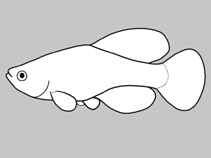
Classificação / Nomes
Nomes comuns | Sinônimos | Catalog of Fishes(Gênero, Espécies) | ITIS | CoL | WoRMS | Cloffa
>
Cyprinodontiformes (Rivulines, killifishes and live bearers) >
Nothobranchiidae (African rivulines)
Etymology: Nothobranchius: Greek, nothos = false + Greek, brangchia = gill (Ref. 45335); cooperi: The specific epithet is given in honour of Barry J. Cooper, renowned collector and breeder of killifish, for his significant contributions to the field study of Nothobranchius and to the killifish hobby in general; a noun in genitive (Ref. 117281).
Eponymy: Barry J Cooper is an American aquarist who collects and breeds killifish. [...] (Ref. 128868), visit book page.
Meio ambiente: milieu / Zona climática / intervalo de profundidade / faixa de distribuição
Ecologia
; Água doce pelágico(a,os,as); pH range: 6.2 - 6.4. Tropical; 24°C - 28°C (Ref. 117281)
Africa: upper reaches of Mansa River, tributary of Luapula River, and seasonal Lufimba system, flowing into Lake Bangeulu, in Zambia (Ref. 117281).
Tamanho / Peso / Idade
Maturidade: Lm ? range ? - ? cm
Max length : 2.6 cm SL macho/indeterminado; (Ref. 117281)
Descrição suscinta
Chaves de identificação | Morfologia | Morfometria
Espinhos dorsais (total) : 0; Raios dorsais (total) : 14 - 16; Espinhos anais: 0; Raios anais : 14 - 16; Vértebras: 26 - 27. Diagnosis: Nothobranchius cooperi belongs to the Nothobranchius brieni species group (Ref. 117281). With the exception of N. rosenstocki and N. sainthousei, it is distinguished from all other species of that group by having broad orange, vs. red brown, posterior scale margins on the trunk and anal fin, with a uniform orange-red margin, vs. light blue, yellow, red-brown or black margin (Ref. 117281). It is distinguished from N. sainthousei by having an anal fin that is uniform orange-red with an irregular to regular, light blue-green zone close to the base, vs. orange-brown spots and orange-brown margin, and a wider, more prominent light blue marginal band to the caudal fin; head length 32.5-36.2% of standard length vs. 25.1-29.3%; prepectoral length 32.5-36.2% of standard length vs. 25.1-29.4%; and head width 70-77% of its depth vs. 79-86% (Ref. 117281). It is distinguished from N. rosenstocki by having a prepelvic length 48.8-51.9% of standard length vs. 45.1-49.0%; and a head depth 75-77% of head length vs. 78-84% (Ref. 117281). Furthermore, the species is characterised by a caudal peduncle length 1.2-1.3 times its depth, compared to 1.4-1.5 times in N. sainthousei, and 1.6 times in N. rosenstocki (Ref. 117281).
It is a micropredator, feeding on small aquatic crustaceans, worms, insect larvae and other zooplankton (Ref. 117281). The species appears to qualify as vulnerable (B1bii) according to IUCN criteria (Ref. 117281).
Ciclo de vida ou comportamento de acasalamento
Maturidade | Reprodução | Desova | Ovos | Fecundidade | Larvas
Nagy, B., B.R. Watters, P.D.W. van der Merve, F.P.D. Cotterill and D.U. Bellstedt, 2017. Nothobranchius cooperi (Teleostei: Cyprinodontiformes): a new species of annual killifish from the Luapula River drainage, northern Zambia. African Journal of Aquatic Science 42(3):201-218. (Ref. 117281)
Status na Lista Vermelha da UICN (Ref. 130435: Version 2025-2 (Global))
Ameaça para os humanos
Harmless
Uso pelos humanos
Ferramentas
Relatórios especiais
Baixar XML
Fontes da internet
Estimativas baseadas em modelos
Índice de diversidade filogenética (Ref.
82804): PD
50 = 0.5000 [Uniqueness, from 0.5 = low to 2.0 = high].
Bayesian length-weight: a=0.01096 (0.00461 - 0.02608), b=2.94 (2.74 - 3.14), in cm total length, based on LWR estimates for this (Sub)family-body shape (Ref.
93245).
Nível Trófico (Ref.
69278): 3.1 ±0.4 se; based on size and trophs of closest relatives
Vulnerabilidade da pesca (Ref.
59153): Low vulnerability (10 of 100).
🛈