>
Pleuronectiformes (Flatfishes) >
Rhombosoleidae (South Pacific flounders)
Etymology: Peltorhamphus: Greek, pelteos, peltes = a fish named as "korakinos"; when it was salted received the name of "pelte" + Greek, rhamphos = bill (Ref. 45335); kryptostomus: Name from Greek 'krypto' meaning hidden and 'stomus' for mouth, referring to the mouth on the ocular side being mostly hidden by the broad rostral flap.
Entorno: milieu / zona climática / rango de profundidad / gama de distribución
Ecología
marino demersal; rango de profundidad 2 - 40 m (Ref. 123823), usually 11 - 20 m (Ref. 123823). Subtropical; 43°S - 47°S (Ref. 123823)
Southwest Pacific: New Zealand.
Longitud en la primera madurez / Tamaño / Peso / Edad
Madurez: Lm ?, range 9 - 10 cm
Max length : 14.5 cm SL macho / no sexado; (Ref. 123823); 14.5 cm SL (female)
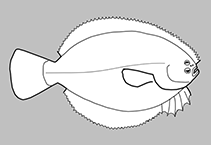
Radios blandos dorsales (total) : 86 - 97; Radios blandos anales: 59 - 67; Vértebra: 37 - 38. This species is distinguished from its congeners by the following set of characters: deep body, with greatest depth anterior to midpoint and with moderately rapid posterior taper; anterior profile of snout is smoothly rounded; second ocular-side pectoral-fin ray is filamentous and shorter than greatest body depth; conspicuous, finger-like filaments 1-5 on inner anteroventral margin of fleshy skinfold on ocular-side lower jaw; no scales on blind sides of dorsal- and anal-fin rays; eyes relatively large with well-developed pupillary operculum; interorbital space relatively narrow (usually < diameter of lower eye) with 2-4 scales; often with 4-6 scales in diagonal row between anteroventral margin of lower (non-migrated) eye and dorsal margin of rostral flap above mouth; gillrakers on first arch long, pointed, robust, with first and sometimes second raker on upper limb overlapping dorsalmost raker(s) on lower limb of first arch; meristic values relatively low (37-38 total vertebrae, 86-97 dorsal- and 59-67 anal-fin rays, 64-82 lateral-line pores, usually 23-24 supracranial pterygiophores, 14-20 total gillrakers on first gill arch, 4-6 on upper limb of first arch); head relatively large and wide; caudal peduncle wide. Colouration: light-brown to light gray ocular-side background with numerous, minute, pinkish spots over entire surface, and with many scales on ocular side of head and body with black pigment on bases of ctenii; the dorsal and anal fins in both sexes with either a pattern of a single darkly pigmented ray alternating with 4-8 lighter-pigmented rays, or with rays uniformly pigmented; black pigmentation on inner lining of ocular-side opercle and entire roof of mouth (Ref. 123823).
Cross section: flattened.
This is a shallow-water species that occurs in 1.5-40 m, with majority of specimens (70 of 81) examined were caught between 11 m and 20 m (8 of 81 collected in 1.5-5.0 m, 2 of 81 taken at 21 m; and only 1 was taken at 40 m. Little else is known about the ecology of this species (Ref. 123823).
Ciclo vital y comportamiento de apareamiento
Madurez | Reproducción | Puesta | Huevos | Fecundidad | Larva
Munroe, T.A., 2021. Systematic revision of the flatfish genus Peltorhamphus Günther, 1862 (Teleostei: Pleuronectiformes: Rhombosoleidae), including description of a new species from Southeastern New Zealand, with biological and ecological summaries for the species. Zootaxa 4905(1):1-104. (Ref. 123823)
Situación en la Lista Roja de la UICN (Ref. 130435: Version 2025-2 (Global))
Amenaza para el ser humano
Harmless
Usos humanos
Herramientas
Informes especiales
Descargar XML
Fuentes de Internet
Estimaciones basadas en modelos
Índice de diversidad filogenética (Referencia
82804): PD
50 = 0.5625 [Uniqueness, from 0.5 = low to 2.0 = high].
Bayesian length-weight: a=0.00389 (0.00180 - 0.00842), b=3.12 (2.94 - 3.30), in cm total length, based on all LWR estimates for this body shape (Ref.
93245).
Nivel trófico (Referencia
69278): 3.1 ±0.2 se; based on size and trophs of closest relatives
Resiliencia (Referencia
120179): Alto, población duplicada en un tiempo mínimo inferior a 15 meses (Preliminary K or Fecundity.).
Vulnerabilidad pesquera (Ref.
59153): Low vulnerability (10 of 100).
🛈