Classification / Noms
Noms communs | Synonymes | Catalog of Fishes(Genre, Espèce) | ITIS | CoL | WoRMS | Cloffa
>
Pleuronectiformes (Flatfishes) >
Cynoglossidae (Tonguefishes) > Symphurinae
Etymology: Symphurus: Greek, syn, symphysis = grown together + Greek, oura = tail (Ref. 45335); polylepis: Name from Greek 'poly' meaning many, and 'lepis' for scale, referring to the greater number of longitudinal scale rows compared with that of similar species of shallow-water tonguefishes.
Environnement : milieu / zone climatique / profondeur / gamme de distribution
Écologie
marin démersal; profondeur 0 - 23 m (Ref. 126065), usually 0 - 10 m (Ref. 126065). Tropical
Western Pacific: Papua New Guinea.
Taille / Poids / Âge
Maturité: Lm ? range ? - ? cm
Max length : 5.0 cm SL mâle / non sexé; (Ref. 126065); 3.5 cm SL (female)
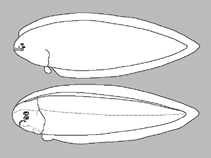
Rayons mous dorsaux (Total) : 84 - 87; Rayons mous anaux: 68 - 74; Vertèbres: 46 - 48. is distinguished from all congeners by the combination of: ID pattern1-2-2-2-2 ; caudal-fin rays 12; vertebrae, 9 (3 +6) abdominal, 46-48 total; hypurals 4; D 84-87, A 68-74; longitudinal scale rows 88-94; transverse scale rows 32-34; scale rows on head posterior to lower orbit 17-19; fleshy ridge well developed on posterior part of ocular-side lower jaw; fleshy membrane covering both eyes; anterior margin of upper eye usually slightly in advance of anterior margin of lower eye; with fleshy flap continuous between ocular-side anterior nostril and anterior region of lower eye; upper head lobe is usually wider than lower head lobe; head length moderately long (HL = 21.9-23.8% of SL) and relatively large postorbital length (POL = 15.7-16.6% of SL, 69.3-73.3% of HL); preanal length relatively short (PAL = 23.5-24.6% of SL); snout short (SNL = 16.0-18.3% of HL, SNL/ED = 1.44-1.86), rounded to obliquely blunt anteriorly; head length usually shorter than head width (HW/HL= 1.02-1.14); dorsal-fin origin in posterior position at, or slightly posterior to, vertical through posterior margin of upper eye; predorsal length moderately long (PDL = 5.7-7.1% of SL; 24.4-31.4% of HL). Colouration: ocular side uniformly yellow to light-brown, blind side uniformly white, both sides with obvious dermal spots on bases of anteriormost dorsal- and anal-fin rays, and peritoneum bluish-black (Ref. 126065).
Cross section: flattened.
More accurate information about geographic distribution, bathymetric distribution and substrata where this species is found needed to better understand the ecology, distribution and life history of this species (Ref. 126065).
Cycle de vie et comportement reproducteur
Maturité | Reproduction | Frai | Œufs | Fécondité | Larves
Lee, M.-Y. and T.A. Munroe, 2021. Unraveling cryptic diversity among shallow-water tonguefishes (Pleuronectiformes: Cynoglossidae: Symphurus) from the Indo-West Pacific region, with descriptions of five new species. Zootaxa 5039(1):1-5.5 (Ref. 126065)
Statut dans la liste rouge de l'IUCN (Ref. 130435: Version 2025-2 (Global))
Menace pour l'homme
Harmless
Utilisations par l'homme
Outils
Articles particuliers
Télécharger en XML
Sources Internet
Estimations basées sur des modèles
Indice de diversité phylogénétique (Réf.
82804): PD
50 = 0.5000 [Uniqueness, from 0.5 = low to 2.0 = high].
Bayesian length-weight: a=0.00427 (0.00211 - 0.00863), b=3.14 (2.97 - 3.31), in cm total length, based on LWR estimates for this Genus-body shape (Ref.
93245).
Niveau trophique (Réf.
69278): 3.2 ±0.4 se; based on size and trophs of closest relatives
Résilience (Réf.
120179): Haut, temps minimum de doublement de population inférieur à 15 mois (Preliminary K or Fecundity.).
Vulnérabilité de la pêche (Ref.
59153): Low vulnerability (10 of 100).
🛈