Klassifizierung / Names
Namen | Synonyme | Catalog of Fishes(Gattung, Arten) | ITIS | CoL | WoRMS | Cloffa
>
Cyprinodontiformes (Rivulines, killifishes and live bearers) >
Procatopodidae (African lampeyes) > Procatopodinae
Etymology: Plataplochilus: Greek, platys = flat + Greek, hoplon = weapon + Greek, cheilos = lip (Ref. 45335); eliasi: In the naming of this new species, the authors extend the sentiment of the Congolese tradition of the burying of a newborn baby's placenta under a large tree in the child's village of birth, representing a wish for growth, wisdom and strength for the child's soul; this species is named for Elias Charly Arnaud Robert de Blic, a child no longer physically here, but remembered in this small fish in a forest stream, a space that is very much living and alive (Ref. 125987).
Umwelt: Milieu / Klimazone / Tiefenbereich / Verbreitungsgebiet
Ökologie
; süßwasser pelagisch. Tropical
Africa: Bondo River catchment, tributary of Noumbi River basin in Republic of the Congo (Ref. 125987).
Größe / Gewicht / Alter
Geschlechtsreife: Lm ? range ? - ? cm
Max length : 4.1 cm SL Männchen/unbestimmt; (Ref. 125987); 3.3 cm SL (female)
Kurzbeschreibung
Bestimmungsschlüssel | Morphologie | Morphometrie
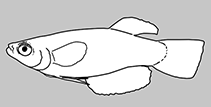
Rückenflossenstacheln (insgesamt) : 0; Rückenflossenweichstrahlen (insgesamt) : 12 - 13; Afterflossenstacheln: 0; Afterflossenweichstrahlen: 16 - 18. Diagnosis: Plataplochilus eliasi belongs to Plataplochilus by the anterior portion of the alveolar arm of the premaxilla developed into a squared process, the dorsoposterior process of the autolapalatine directed upwards, an elliptical supracleithrum, the dorsoposterior border of the cleithrum broad and posteriorly elongated, a rectangular and anteroposteriorly elongated lachrymal, and the presence of an upper lobe extension in the caudal fin of males (Ref. 125987). It differs from all described Plataplochilus species by the unique colour pattern of adult males: the flank above the mid-longitudinal line is brownish to olive green whereas the lower half of the flank and the operculum are bright dark blue; a large, round dark blue to black spot is present on the operculum; and a broad submarginal black band is present from the origin of the anal fin to end of the caudal peduncle; Plataplochilus chalcopyrus, P. mimus, P. ngaensis and P. terveri are lacking this band and opercular spot, and have a silvery lower flank with a blueish, greenish or brownish iridescence (Ref. 125987). Plataplochilus eliasi differs from P. pulcher and P. miltotaenia by lacking a narrow longitudinal red line on the flank; the colour pattern of P. cabindae, P. micrurus and P. loemensis is not known; Plataplochilus micrurus has the largest predorsal distance of all Plataplochilus species, 73% of standard length vs. less than 64%, and a strikingly lower number of dorsal and anal-fin rays, respectivelt 6 and 12 vs. 9-16 and 14-18 in all other species, 12-13 and 16-18 in P. eliasi (Ref. 125987). Furthermore, the new species also differs from all described Plataplochilus species by having a deeper body; adult males are the deepest of all species in the genus, 38.4-42.4% of standard length vs. less than 36.2%; all other described species have more slender bodies (Ref. 125987). In addition, Plataplochilus eliasi differs from all described species except P. miltotaenia by having 12-13 dorsal fin rays, vs. 13-16 in P. miltotaenia and less than 13 in all other species; it is similar to P. miltotaenia, P. terveri and P. loemensis by having 7-8 scales in a transversal row, distinguishing it from all other congeners, which have only 6 scales; Plataplochilus eliasi is also distinguished from P. miltotaenia by having the first ray of the dorsal fin inserted above anal-fin rays 4-5, vs. 1-3 in P. miltotaenia; adult females of P. eliasi have a rather similar colour pattern to other species of the genus, but can be easily distinguished from P. miltotaenia females by lacking a narrow mid-lateral longitudinal red line (Ref. 125987).
Cross section: compressed.
Plataplochilus eliasi is found in very shallow, clear-water creeks over diverse substrate types consisting of boulders, cobbles and pebbles with Anubias sp. and overhanging vegetation (Ref. 125987). It appears to have a strong preference for fast-flowing stream sections on steep slopes (Ref. 125987).
Lebenszyklus und Paarungsverhalten
Geschlechtsreife | Fortpflanzung | Ablaichen | Eier | Fruchtbarkeit | Larven
Walsh, G., PH.N. de Bragança and J. van der Zee, 2022. Plataplochilus eliasi (Cyprinodontiformes: Procatopodidae) a new species from the upper Noumbi River in the Republic of the Congo. J. Nat. Hist. 55(45-46):2849-2867. (Ref. 125987)
IUCN Rote Liste Status (Ref. 130435: Version 2025-2 (Global))
Bedrohung für Menschen
Harmless
Nutzung durch Menschen
Fischereien: nicht kommerziell
Tools
Zusatzinformationen
Download XML
Internet Quellen
Schätzungen auf der Grundlage von Modellen
Phylogenetischer Diversitätsindex (Ref.
82804): PD
50 = 0.5020 [Uniqueness, from 0.5 = low to 2.0 = high].
Bayesian length-weight: a=0.01122 (0.00514 - 0.02450), b=3.04 (2.87 - 3.21), in cm total length, based on all LWR estimates for this body shape (Ref.
93245).
Trophische Ebene (Ref.
69278): 3.2 ±0.4 se; based on size and trophs of closest relatives
Anfälligkeit der Fischerei (Ref.
59153): Low vulnerability (10 of 100).
🛈