การจำแนกประเภท / ชื่อ
ชื่อสามัญ | ชื่อพ้อง | Catalog of Fishes(สกุล, ชนิด) | ITIS | CoL | WoRMS | Cloffa
sub class Elasmobranchii (ฉลามและกระเบน) (sharks and rays) >
Rajiformes (Skates and rays) >
Arhynchobatidae (Softnose skates)
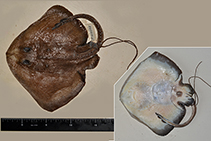
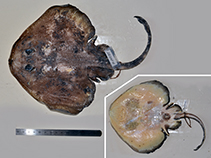
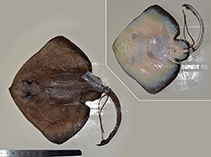
Etymology: sexoculata: Named for the color pattern of the species, the six white blotches (ocelli) on the dorsal disc.
สิ่งแวดล้อม : สิ่งแวดล้อม / เขตภูมิอากาศ / ระดับความลึก / ระยะการกระจายสินค้า
นิเวศวิทยา
เกี่ยวกับทะเล,น้ำเค็ม สัตว์น้ำหน้าดิน; ระดับความลึก ? - 150 m (Ref. 123274). Temperate
Northwest Pacific: Simushir Island, Kuril Islands.
ขนาด / น้ำหนัก / อายุ
วัยเจริญพันธุ์: Lm ? range ? - ? cm
Max length : 35.2 cm TL เพศผู้/กระเทย; (Ref. 123274); 28.6 cm TL (female)
คำอธิบายสั้นๆ
เครื่องมือที่ใช้ในการแยกชนิดสัตว์,สิ่งมีชีวิตออกจากกัน | สัณฐานวิทยา | ความยาวต่างๆ
This medium-sized species (ca. max. size 80.0 cm TL, 55.0 cm DW) is distinguished by the following set of characters: dorsal ground color is reddish-brown or greenish-brown, with three pairs of white blotches on disc located beside eyes, and on shoulders and posterior half of disc; lateral margin of tail with 4 or 5 pairs of white blotches located at the tail origin, midpoint, D1 origin, and on inter-dorsal space; ventral surface is almost entirely white; dark blotch around cloaca, dark bands along mid ventral line of tail; dorsal surface of disc with a single scapular thorn, 3-4 nuchal thorns; tail with 20-24 regularly arranged thorns; the median row of thorns discontinuous, no mid-dorsal thorns; orbital thornlets along medial rim of orbit; dorsal surface of disc and tail with fine prickles; prickle band on mid-disc extending along sides of tail; prickles on pectoral fin base relatively sparse; ventral surface is uniformly smooth; disc width 63.1-65.6% TL, length 50.6-53.5% TL; anterior projection (snout to maximum width) 29.7-32.2% TL; head length (dorsal aspect) 18.9-20.6% TL; snout broad and moderately short, preoral length 11.1-14.1% TL, supported by slender, flexible unsegmented cartilage; snout angle 103-119º; eyes rather large with eye diameter 0.22-0.24 times head length, 1.00-1.11 times between orbits; tail relatively long (but shorter than disc width), length 51.5-54.1% TL and 0.79-0.86 times DW, width at first dorsal fin origin 3..8-4.2% tail length; predorsal caudal vertebrae 86-93 (Ref. 123274).
Cross section: flattened.
วงจรชีวิตและพฤติกรรมการผสมพันธุ์
วัยเจริญพันธุ์ | การสืบพันธุ์ | การวางไข่ | เซลสืบพันธ์ของเพศเมีย(ไข่) | ความดกของไข่ | ตัวอ่อน
Misawa, R., A.M. Orlov, S.Y. Orlova, I.I. Gordeev, H. Ishihara, T. Hamatsu, Y. Ueda, K. Fujiwara, H. Endo and Y. Kai, 2020. Bathyraja (Arctoraja) sexoculata sp. nov., a new softnose skate (Rajiformes: Arhynchobatidae) from Simushir Island, Kuril Islands (western North Pacific), with special reference to geographic variations in Bathyraja (Arctoraja) smirnovi. Zootaxa 4861(4):515-543. (Ref. 123274)
สถานะบัญชีแดงของ IUCN (Ref. 130435: Version 2025-2 (Global))
ภัยคุกคามต่อมนุษย์
Harmless
การใช้ของมนุษย์
เครื่องมือ
รายงานพิเศษ
ดาวน์โหลด XML
แหล่งที่มาจากอินเตอร์เน็ต
การประมาณค่าตามแบบจำลอง
ดัชนีความหลากหลายทางวิวัฒนาการ (อ้างอิง
82804): PD
50 = 0.6250 [Uniqueness, from 0.5 = low to 2.0 = high].
Bayesian length-weight: a=0.00550 (0.00279 - 0.01081), b=3.11 (2.94 - 3.28), in cm total length, based on LWR estimates for this (Sub)family-body shape (Ref.
93245).
ระดับชั้นอาหาร (อ้างอิง
69278): 3.7 ±0.6 se; based on size and trophs of closest relatives
ความสามารถในการกลับคืนสู่ปกติ (อ้างอิง
120179): ขนาดกลาง, เวลาต่ำสุดที่จะทำให้ประชากรเพิ่มขึ้นเป็น 2 เท่าใช้เวลา 1.4 - 4.4 ปี (Preliminary K or Fecundity.).
ความเสี่ยงต่อการตกปลา (Ref.
59153): Low to moderate vulnerability (25 of 100).
🛈