>
Gobiiformes (Gobies) >
Gobiidae (Gobies) > Sicydiinae
Etymology: Lentipes: Latin, lens, lentis = slow + Latin, pes = foot (Ref. 45335); palawanirufus: Named for its type locality, Palawan, Latin word 'rufus' meaning red, with a connecting-vowel, 'i' referring to the red Lentipes of Palawan; treated as an adjective.
Milieu: milieu / Klimaatzone / Diepte / verspreidingsgebied
Ecologie
; zoet water benthopelagisch. Tropical
Asia: Philippines.
Grootte / Gewicht / Leeftijd
Maturiteit: Lm ? range ? - ? cm
Max length : 4.7 cm SL mannelijk / geslacht onbekend; (Ref. 125534); 4.9 cm SL (female)
Korte beschrijving
Determinatiesleutels | Morfologie | Morfometrie
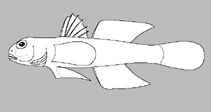
Dorsale stekels (totaal) : 7; Dorsale zachte stralen (totaal) : 10; Anale stekels: 1; Anale zachte stralen: 10. This species is distinguished from all its congeners by having the following set of characters: D2 and A I, 10; pectoral fin rays usually 18-19; fourth and/or fifth spines longest in first dorsal fin of male; no or small interval between first- and second-dorsal-fin bases in male (less than 1/3 of the length of the first-dorsal-fin base; the fin bases are often connected); cephalic sensory pore D single; preopercular sensory canal usually with two (M’ and O’) or three pores (M’, N, and O’); without enlarged lobes or projections in front of the urogenital papilla of males; lateral scales reaching anteriorly beyond the area below the origin of the first dorsal fin; scales with large, spike-like ctenii laterally on the trunk in male. Colouration of male with a broad, reddish-brown or dark-red band between bases of the second dorsal and anal fins, red, reddish-brown, or dark-brown head, belly without clear black lines, second dorsal fin being reddish brown or dark red proximally and white or light yellowish brown distally, a black spot at anterior part of second dorsal fin, and anal fin being reddish brown or dark red proximally and translucent distally (Ref. 125534).
Cross section: oval.
This species was commonly observed with many other goby species and two cyprinid species at the reaches below the first waterfall of Estrella Falls. It was more abundant at the reaches above the waterfal, a habitat it occupies together with Sicyopus zosterophorus. In the Olanguan Falls which consists of continuous waterfalls along the course of one stream. this species co-occurred with many other goby species, a cyprinid species, and two Kuhlia species (Ref. 125534).
Levenscyclus en paargedrag
Maturiteit | Voortplanting | Paaien | Eieren | Fecunditeit | Larven
Maeda, K., H. Kobayashi, H.P. Palla, C. Shinzato, R. Koyanagi, J. Montenegro, A.J. Nagano, T. Saeki, T. Kunishima, T. Mukai, K. Tachihara, V. Laudet, N. Satoh and K. Yamahira, 2021. Do colour-morphs of an amphidromous goby represent different species? Taxonomy of Lentipes (Gobiiformes) from Japan and Palawan, Philippines, with phylogenomic approaches. Systematics and Biodiversity 19(8):1080-1112. (Ref. 125534)
Status op de Rode Lijst van het IUCN (Ref. 130435: Version 2025-2 (Global))
Gevaar voor de mens
Harmless
Gebruik door de mens
Tools
Speciale rapporten
Download XML
Internetbronnen
Schattingen op basis van modellen
Fylogenetische diversiteitsindex (Ref.
82804): PD
50 = 0.5000 [Uniqueness, from 0.5 = low to 2.0 = high].
Bayesian length-weight: a=0.00389 (0.00180 - 0.00842), b=3.12 (2.94 - 3.30), in cm total length, based on all LWR estimates for this body shape (Ref.
93245).
Weerstandsvermogen (Ref.
120179): Hoog, minimale populatieverdubbelingstijd minder dan 15 maanden (Preliminary K or Fecundity.).
Kwetsbaarheid van de visserij (Ref.
59153): Low vulnerability (10 of 100).
🛈