>
Gobiiformes (Gobies) >
Gobiidae (Gobies) > Sicydiinae
Etymology: Lentipes: Latin, lens, lentis = slow + Latin, pes = foot (Ref. 45335); bunagaya: Named after a creature in Okinawan mythology known especially in Ogimi Village in the northern part of the island, Bunagaya; noun in apposition.,.
Ambiente: milieu / zona climática / intervalo de profundidade / gama de distribuição
Ecologia
; Água doce bentopelágico. Subtropical
Asia: Japan and Taiwan.
Tamanho / Peso / Idade
Maturidade: Lm ? range ? - ? cm
Max length : 2.5 cm SL macho/indeterminado; (Ref. 125534)
Descrição breve
Chaves de identificação | Morfologia | Morfometria
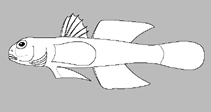
Espinhos dorsais (total) : 7; Raios dorsais moles (total) : 10; Espinhos anais: 1; Raios anais moles: 10. This species is distinguished from all its congeners by the following set of characters: D2 I,10; A I,10; pectoral fin rays 18-19; D1 with fourth and/or fifth spines longest in male; interval between first- and second-dorsal-fin bases in male less than 1/3 of the length of the first-dorsal-fin base; cephalic sensory pore D single; preopercular sensory canal with two pores, M’ and O’; enlarged lobes or projections in front of the urogenital papilla of male absent; lateral scales reaching anteriorly beyond the area below the origin of the first dorsal fin; male scales with large, spike-like ctenii laterally on the trunk. Colouratiion of male: with two broad red bands on the posterior part of the body, three black vertical lines on grey or light-blue belly, grey or greyish-brown head without red marking, second dorsal fin being reddish brown proximally and white distally, a black spot at anterior part of second dorsal fin, and anal fin white with obscure reddish-brown base (Ref. 125534).
Cross section: oval.
Ciclo de vida e comportamento de acasalamento
Maturidade | Reprodução | Desova | Ovos | Fecundidade | Larvas
Maeda, K., H. Kobayashi, H.P. Palla, C. Shinzato, R. Koyanagi, J. Montenegro, A.J. Nagano, T. Saeki, T. Kunishima, T. Mukai, K. Tachihara, V. Laudet, N. Satoh and K. Yamahira, 2021. Do colour-morphs of an amphidromous goby represent different species? Taxonomy of Lentipes (Gobiiformes) from Japan and Palawan, Philippines, with phylogenomic approaches. Systematics and Biodiversity 19(8):1080-1112. (Ref. 125534)
Categoria na Lista Vermelha da IUCN (Ref. 130435: Version 2025-2 (Global))
Ameaça para o homem
Harmless
Utilização humana
Ferramentas
Relatórios especiais
Descarregue XML
Fontes da internet
Estimativas baseadas em modelos
Índice de diversidade filogenética (Ref.
82804): PD
50 = 0.5000 [Uniqueness, from 0.5 = low to 2.0 = high].
Bayesian length-weight: a=0.00389 (0.00180 - 0.00842), b=3.12 (2.94 - 3.30), in cm total length, based on all LWR estimates for this body shape (Ref.
93245).
Resiliência (Ref.
120179): Elevada, tempo mínimo de duplicação da população menor que 15 meses (Preliminary K or Fecundity.).
Vulnerabilidade da pesca (Ref.
59153): Low vulnerability (10 of 100).
🛈