Elasmobranquios (tiburones y rayas) (sharks and rays) >
Squaliformes (Sleeper and dogfish sharks) >
Dalatiidae (Sleeper sharks)
Etymology: Mollisquama: mollis (L.), soft; squama (L.), scale, referring to its soft scales, apparently unique among sharks (See ETYFish); mississippiensis: -ensis, Latin suffix denoting place: the “vast” North American Mississippi River Basin, a “biologically and geographically rich region that nurtures Gulf of Mexico [type locality] fauna and unites diverse cultures” (See ETYFish).
Taxonomic Remarks
Previously identified as Mollisquama parini Dolganov, 1984.
Entorno: milieu / zona climática / rango de profundidad / gama de distribución
Ecología
marino batipelágico. Deep-water
Western Central Atlantic: Gulf of Mexico.
Tamaño / Peso / Edad
Madurez: Lm ? range ? - ? cm
Max length : 14.2 cm TL macho / no sexado; (Ref. 121924)
Descripción breve
Claves de identificación | Morfología | Morfometría
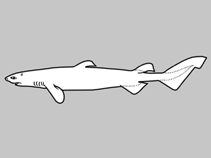
This species is distinguished from its congeners by the following characters: a putative pit organ centrally placed just posterior to the lower jaw margin; photophores are irregularly distributed along many areas of the body; with a series of 16 ventral-abdominal photophore aggregations; upper teeth no labial-surface ridge (vs. present in M. parini); lower teeth with a weak or absent basal sulcus (vs. deep sulcus in M. parini) (Ref. 121924).
Cross section: circular.
This species was collected with a midwater trawl during a cetacean research project to assess predator/prey trophodynamics for sperm whales (Physeter macrocephalus) of the Gulf of Mexico. Trawl fishing depths were from 5 m of surface to a maximum trawl fishing depth of 580 m over 3,038 m bottom depth; with the sea bottom relatively flat abyssal plain without significant bathymetric features. Environmental sampling conducted within 10 nautical miles of the trawl location with surface/maximum trawling depth environmental data; temperature 21.5°C/7.2°C, oxygen saturation 6.6 mg/l/ 4.0 mg/l, and salinity 36.5 psu/34.9 psu. Other fauna were captured including 44 species identified to lowest taxon (3.3 kg total catch weight, 731 specimens); 29 finfish taxa, 15 invertebrate taxa. Collection locations of M. mississippiensis captured above an abyssal plain 3,038 m depth is influenced by the relatively warm Gulf Stream while M. parini captured above an extensive seamount ridge 330 m depth is influenced by the relatively cold sub-Antarctic Humboldt Current (Ref. 121924).
Ciclo vital y comportamiento de apareamiento
Madurez | Reproducción | Puesta | Huevos | Fecundidad | Larva
Grace, M.A., M.H. Doosey, J.S. Denton, G.J.P. Naylor, H.L. Bart Jr. and J.G. Maisey, 2019. A new Western North Atlantic Ocean kitefin shark (Squaliformes: Dalatiidae) from the Gulf of Mexico. Zootaxa 4619(1):109-120. (Ref. 121924)
Situación en la Lista Roja de la UICN (Ref. 130435: Version 2025-2 (Global))
Amenaza para el ser humano
Harmless
Usos humanos
Herramientas
Informes especiales
Descargar XML
Fuentes de Internet
Estimaciones basadas en modelos
Índice de diversidad filogenética (Referencia
82804): PD
50 = 0.7510 [Uniqueness, from 0.5 = low to 2.0 = high].
Bayesian length-weight: a=0.00309 (0.00143 - 0.00669), b=3.14 (2.94 - 3.34), in cm total length, based on LWR estimates for this (Sub)family-body shape (Ref.
93245).
Nivel trófico (Referencia
69278): 3.8 ±0.3 se; based on size and trophs of closest relatives
Resiliencia (Referencia
120179): Alto, población duplicada en un tiempo mínimo inferior a 15 meses (Preliminary K or Fecundity.).
Vulnerabilidad pesquera (Ref.
59153): Low vulnerability (10 of 100).
🛈