klasifikasi / Nama
Nama-nama umum | Sinonim (persamaan) | Catalog of Fishes(Marga, Jenis) | ITIS | CoL | WoRMS | Cloffa
>
Cyprinodontiformes (Rivulines, killifishes and live bearers) >
Procatopodidae (African lampeyes) > Procatopodinae
Etymology: Hylopanchax: Greek, hylo, hyle = material, wood + Panchax, a word created by Meinken in 1932; multisquamatus: The name is derived from the Latin term multi meaning 'many' and squama meaning 'scale' and refers to the high number in mid-longitudinal scales (Ref. 123864).
Lingkungan: lingkungan / zona iklim / kisaran kedalaman / jangkauan distribusi
Ekologi
; air tawar pelagis, permukaan. Tropical
Africa: tributaries of the Ivindo River drainage, a right-bank affluent of the Ogowe River basin, in Gabon (Ref. 123864).
Ukuran / Berat / umur
Kematangan: Lm ? range ? - ? cm
Max length : 2.3 cm SL jantan/; (Ref. 123864); 2.1 cm SL (female)
deskripsi pendek
Kunci identifiaksi (pengenalan) | Morfologi | Morfometrik
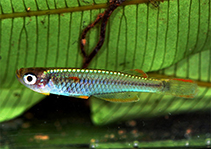
Duri punggung (Keseluruhan (total)) : 0; duri punggung lunak (Keseluruhan (total)) : 7 - 8; Duri dubur: 0; Sirip dubur lunak: 13 - 16; vertebrata, bertulang belakang: 31 - 32. Diagnosis: Hylopanchax multisquamatus is distinguished from its congeners by the presence of more scales along the mid-longitudinal series of scales, 27-30 vs. 19-26, and by the possession of an anterior/posterior flank scale height ration, 140%-150% vs. 170%-220% (Ref. 123864). It is distinguished from H. stictopleuron by the number of scales in transversal row, 6 vs. 5; in addition, H. multisquamatus is distinguished from congeners except Hylopanchax thysi, by the presence of a hyaline urogenital male papilla with small black spots in preserved specimens vs. black, and by the presence of a dark-brown reticulate pattern on the flank of both males and females vs. absence or less-conspicuous pattern; finally, H. multisquamatus is distinguished from H. thysi by the presence of 11-12 pectoral-fin rays vs. 13-14, a male caudal peduncle depth-length ratio between 40-45% vs. 53-59%, a body depth of 20.0-23.7% of standard length vs. 25.2-27.8%, a female predorsal length between 66.0-74.8% of standard length vs. 62.0-64.0%, and a female prepelvic length of 42.1-45.1% of standard length vs. 33.7-38.0% (Ref. 123864).
Cross section: compressed.
This species inhabits shallow creeks inside dense forest areas (Ref. 123864).
Siklus hidup dan perilaku kawin
Kematangan | Reproduksi, perkembang biakan | Pemijahan | telur-telur | Fekunditas | Larva
Bragança, P.H.N., J.R. van der Zee, R. Sonnenberg and E.J.W.M.N. Vreven, 2021. Description of two new miniature species of Hylopanchax Poll & Lambert, 1965 (Cypriniformes: Procatopodidae) from northeastern Gabon, with an updated diagnosis of the genus based on morphology, colouration and osteology. J. Fish Biol. 98(3):655-667. (Ref. 123864)
Status IUCN Red List (Ref. 130435: Version 2025-2 (Global))
ancaman kepada manusia
Harmless
penggunaan manusia
Alat, peralatan
laporan khas
muat turun XML
Sumber internet
Estimasi berdasarkan model
Indeks keanekaragaman filogenetik (Acuan
82804): PD
50 = 0.5039 [Uniqueness, from 0.5 = low to 2.0 = high].
Bayesian length-weight: a=0.01122 (0.00514 - 0.02450), b=3.04 (2.87 - 3.21), in cm total length, based on all LWR estimates for this body shape (Ref.
93245).
Tingkat Trofik (Acuan
69278): 3.1 ±0.4 se; based on size and trophs of closest relatives
Kerentanan Penangkapan Ikan (Ref.
59153): Low vulnerability (10 of 100).
🛈