>
Notacanthiformes (Halosaurs and deep-sea spiny eels) >
Halosauridae (Halosaurs)
Etymology: Halosauropsis: Greek, als, alis = salt + Greek, sauros = lizard + Greek, opsis = appearance (Ref. 45335).
More on author: Günther.
Umwelt: Milieu / Klimazone / Tiefenbereich / Verbreitungsgebiet
Ökologie
seewasser bathydemersal; tiefenbereich 1100 - 3300 m (Ref. 4448). Deep-water; 50°N - 47°S
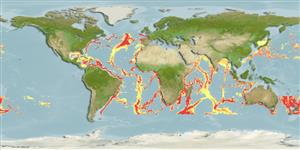
Eastern Atlantic: Ireland to Mauritania and South Africa. Western Atlantic: Canada to 25°N, and off southern Brazil. Western Pacific: Australia (Ref. 7300), New Zealand and Japan (Ref. 37335). Also known from Western Indian Ocean.
Größe / Gewicht / Alter
Geschlechtsreife: Lm ? range ? - ? cm
Max length : 90.0 cm TL Männchen/unbestimmt; (Ref. 4448)
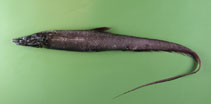
Rückenflossenstacheln (insgesamt) : 0; Rückenflossenweichstrahlen (insgesamt) : 11 - 13. Body greyish-black to bluish black in color; top of head, gill isthmus and branchiostegal membranes black (Ref. 3974). Deeply pigmented sheath of lateral line. Absence of scales on the top of the head and presence of scales on the opercular bone (Ref. 37108).
Body shape (shape guide): eel-like.
Found on the lower slope, continental rise and upper abyss, primarily between 4° and 2°C isotherms. Feeds on polychaetes, crustaceans, echinoderms and echiurids. Hovers above or rests on bottom. Long slender pectorals are commonly held erect pointing upward and forward, these may serve a sensory function (Ref. 6727).
Lebenszyklus und Paarungsverhalten
Geschlechtsreife | Fortpflanzung | Ablaichen | Eier | Fruchtbarkeit | Larven
Sulak, K.J., 1990. Halosauridae. p. 126-132. In J.C. Quero, J.C. Hureau, C. Karrer, A. Post and L. Saldanha (eds.) Check-list of the fishes of the eastern tropical Atlantic (CLOFETA). JNICT, Lisbon; SEI, Paris; and UNESCO, Paris. Vol. 1. (Ref. 4448)
IUCN Rote Liste Status (Ref. 130435: Version 2025-2 (Global))
Bedrohung für Menschen
Harmless
Nutzung durch Menschen
Fischereien: nicht kommerziell
Tools
Zusatzinformationen
Download XML
Internet Quellen
Schätzungen auf der Grundlage von Modellen
Bevorzugte Temperatur (Ref.
123201): 2.3 - 5, mean 3.3 °C (based on 1404 cells).
Phylogenetischer Diversitätsindex (Ref.
82804): PD
50 = 1.0000 [Uniqueness, from 0.5 = low to 2.0 = high].
Bayesian length-weight: a=0.00087 (0.00033 - 0.00229), b=3.07 (2.84 - 3.30), in cm total length, based on LWR estimates for this (Sub)family-body shape (Ref.
93245).
Trophische Ebene (Ref.
69278): 3.3 ±0.36 se; based on food items.
Widerstandsfähigkeit (Ref.
120179): niedrig, Verdopplung der Population dauert 4,5 - 14 Jahre. (Assuming tmax>10).
Anfälligkeit der Fischerei (Ref.
59153): Moderate vulnerability (41 of 100).
🛈
Nährstoffe (Ref.
124155): Calcium = 12.2 [3.5, 43.0] mg/100g; Iron = 0.426 [0.139, 1.080] mg/100g; Protein = 2.36 [0.00, 6.23] %; Omega3 = 0.308 [0.110, 0.875] g/100g; Selenium = 24.3 [6.7, 82.0] μg/100g; VitaminA = 5.02 [0.95, 23.69] μg/100g; Zinc = 0.317 [0.164, 0.626] mg/100g (wet weight);