Elasmobranquios (tiburones y rayas) (sharks and rays) >
Rajiformes (Skates and rays) >
Rajidae (Skates)
Etymology: Amblyraja: Greek, amblys = darkness + Latin, raja, -ae = ray (Raja sp.) (Ref. 45335).
Eponymy: This is a toponym referring to the fact that the holotype was caught in the coastal waters of South Georgia and was named after that island. (Ref. 128868), visit book page.
More on author: Norman.
Entorno: milieu / zona climática / rango de profundidad / gama de distribución
Ecología
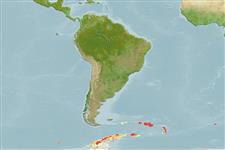
marino batidemersal; rango de profundidad 20 - 350 m (Ref. 58839). Deep-water; 43°S - 74°S, 48°E - 23°W (Ref. 114953)
Southeast Pacific: Chile (Ref. 27540). Southern Ocean: around South Georgia Island and on the ridge westward towards Black Rocks. Occasionally seen on the Scotia Ridge.
Tamaño / Peso / Edad
Madurez: Lm ? range ? - ? cm
Max length : 115 cm TL macho / no sexado; (Ref. 114953)
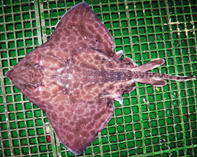
Found on continental and insular shelves, as well as upper slopes. Feeds mainly on small benthic invertebrates (Ref. 114953). Oviparous (Ref. 205). Reaches maturity at 80-90 cm TL; birth size at ca. 20 cm TL (Ref. 114953). Distinct pairing with embrace. Young may tend to follow large objects, such as their mother (Ref. 205). Eggs are oblong capsules with stiff pointed horns at the corners deposited in sandy or muddy flats (Ref. 205). Egg capsule measures 116.5 mm long and 80.0 mm wide (Ref. 41249). Utilized as fishmeal and possibly not utilized for human consumption due to extreme roughness of its squamation (Ref. 5159).
Ciclo vital y comportamiento de apareamiento
Madurez | Reproducción | Puesta | Huevos | Fecundidad | Larva
Oviparous, paired eggs are laid. Embryos feed solely on yolk (Ref. 50449). Distinct pairing with embrace. Young may tend to follow large objects, such as their mother (Ref. 205). Eggs have horn-like projections on the shell (Ref. 205).
McEachran, J.D. and K.A. Dunn, 1998. Phylogenetic analysis of skates, a morphologically conservative clade of elasmobranchs (Chondrichthyes: Rajidae). Copeia 1998(2):271-290. (Ref. 27314)
Situación en la Lista Roja de la UICN (Ref. 130435: Version 2025-2 (Global))
Amenaza para el ser humano
Harmless
Usos humanos
Pesquerías: pesquerías de subsistencia
Herramientas
Informes especiales
Descargar XML
Fuentes de Internet
Estimaciones basadas en modelos
Temperatura preferida (Referencia
123201): -1.4 - 0.5, mean -0.6 °C (based on 28 cells).
Índice de diversidad filogenética (Referencia
82804): PD
50 = 0.5039 [Uniqueness, from 0.5 = low to 2.0 = high].
Bayesian length-weight: a=0.00302 (0.00141 - 0.00645), b=3.24 (3.07 - 3.41), in cm total length, based on LWR estimates for this (Sub)family-body shape (Ref.
93245).
Nivel trófico (Referencia
69278): 4.2 ±0.3 se; based on size and trophs of closest relatives
Resiliencia (Referencia
120179): Bajo, población duplicada en un tiempo mínimo de 4.5-14 años (Assuming tm>5).
Vulnerabilidad pesquera (Ref.
59153): High to very high vulnerability (69 of 100).
🛈
Vulnerabilidad climática (Ref.
125649): Moderate vulnerability (38 of 100).
🛈
Nutrientes (Ref.
124155): Calcium = 3.68 [0.60, 74.79] mg/100g; Iron = 0.312 [0.029, 4.166] mg/100g; Protein = 15.5 [13.4, 17.5] %; Omega3 = 0.393 [0.157, 0.959] g/100g; Selenium = 13.2 [2.4, 63.8] μg/100g; VitaminA = 6.56 [0.48, 84.64] μg/100g; Zinc = 0.219 [0.014, 2.548] mg/100g (wet weight);